
Move beyond telling players where to stand. Learn how to design drills and conversations that develop awareness, decision-making, and problem-solving.
Every hockey coach has experienced it.
You're standing behind the bench watching a play develop.
Your defenseman retrieves the puck behind the net. She has a teammate open along the boards, another moving through the middle, and an opposing forechecker closing in.
You can see exactly what she should do.
So you yell.
"LOOK UP!"
"GO WIDE!"
"PASS IT!"
But by the time those instructions reach her, the opportunity is gone.
The puck gets turned over, the other team creates a scoring chance, and you're left wondering why your players aren't recognizing the same opportunities you see.
Here's the challenge.
We can't make every decision for our athletes. And if we want them to become smarter hockey players, we shouldn't try to.
Hockey is fast, unpredictable, and constantly changing. Players must process information, anticipate what happens next, and make decisions in fractions of a second.
They can't rely on a coach standing on the bench to tell them what to do.
They need to learn how to think the game themselves.
At Breakaway Girls Hockey, we believe developing hockey IQ is one of the most important responsibilities of a coach.
And it starts with changing how we teach.
1. What Is Hockey IQ, Really?
Hockey IQ is one of the most commonly used phrases in player evaluations.
Coaches describe athletes as having "great hockey sense," "seeing the ice well," or "understanding the game."
But what do those phrases actually mean?
Hockey IQ is a player's ability to recognize what's happening around her, understand the available options, anticipate how a situation may develop, and make effective decisions.
It's not simply knowing where to stand during a breakout or memorizing an offensive-zone system.
It's understanding why certain decisions work and recognizing when those decisions need to change.
Five Components of Hockey IQ
1. Awareness
Recognizing where teammates, opponents, the puck, and open space are located.
2. Anticipation
Identifying how a play is developing and predicting what might happen next.
3. Decision-Making
Choosing an appropriate action based on the situation.
4. Adaptability
Adjusting when the original plan is no longer effective.
5. Game Understanding
Recognizing the principles behind offensive, defensive, and transitional play.
These abilities work together.
For example, a player who recognizes an approaching defender may anticipate pressure, identify an open teammate, and make a quick pass before the defender arrives.
That's hockey IQ in action.
Breakaway Coaching Principle: Hockey IQ isn't just knowing what to do. It's recognizing what the game is asking you to do—and responding effectively.
2. Stop Teaching Players to Memorize the Game
Systems and structure are important parts of hockey.
Players need to understand defensive responsibilities, breakout options, offensive positioning, and team concepts.
But there's a difference between teaching a system and teaching players to understand the game.
Consider a traditional breakout drill.
A coach places players in predetermined positions.
The defenseman retrieves the puck, passes to the winger along the boards, and the winger moves it to the center.
Everyone follows the pattern.
The drill looks organized.
But what happens when the opposing forechecker takes away the boards?
What happens when the center isn't available?
What happens when the defenseman has open ice and could carry the puck herself?
If players have only learned to execute a predetermined sequence, they may struggle when the situation changes.
Teach Principles, Not Just Patterns
Instead of teaching only where players should go, teach them what they're trying to accomplish.
For a breakout, those principles might include:
Recognize pressure before retrieving the puck.
Create multiple passing options.
Support the puck carrier at appropriate distances.
Move into available space.
Protect possession when the first option disappears.
Communicate early and clearly.
Now players have a framework they can apply in different situations.
The breakout might look different every time.
But the underlying principles remain consistent.
Breakaway Coaching Tip: A system should give players structure without eliminating their ability to recognize opportunities and make decisions.
3. Teach Players to See Before They Act
One of the foundations of hockey IQ is awareness.
Players need to recognize what's happening around them before deciding what to do.
This sounds simple, but it's a skill that requires practice.
Think about a defenseman retrieving a puck in the corner.
If she only looks at the puck, she may not recognize the forechecker approaching from behind.
But if she checks her surroundings before reaching the puck, she may identify pressure, recognize her passing options, and prepare her next decision.
Develop the Habit of Scanning
Scanning means actively looking around to gather information about the game.
Encourage players to check their surroundings:
Before receiving a pass
While approaching a loose puck
During offensive-zone movement
When transitioning from offense to defense
Before making a breakout decision
When supporting a teammate
Coaching Example: Puck Retrieval With Awareness
Setup: Place a defenseman near the boards with a puck positioned behind the net.
Have a teammate available as a passing option and a forechecker applying controlled pressure.
Objective: The defenseman retrieves the puck and chooses an appropriate exit.
Coaching Focus:
Does she look before reaching the puck?
Does she recognize where pressure is coming from?
Does she identify her passing options?
Does she adjust when an option is taken away?
Progression
Begin with predictable pressure.
Then vary the forechecker's approach.
Eventually, allow the defender to make an independent decision about whether to pass, reverse, or carry the puck.
Breakaway Coaching Tip: Don't simply tell players to "look up." Teach them what information they're looking for and how that information influences their decisions.
4. Design Drills That Require Decisions
One of the biggest limitations of traditional hockey drills is predictability.
Players often know exactly where to skate, who to pass to, and when to shoot.
That can be useful when introducing a technical skill.
But if every activity has a predetermined outcome, players have limited opportunities to practice decision-making.
Closed Drills vs. Open Drills
Closed Drills
The coach determines the movement and outcome in advance.
Example: Skate around a cone, pass to a teammate, receive the puck back, and shoot.
Open Drills
The player must respond to changing information.
Example: Enter the offensive zone with two passing options while a defender decides which lane to take away.
Both approaches have value.
The key is understanding when to use each.
Example: Turn a Basic 2-on-1 Into a Decision-Making Drill
A traditional 2-on-1 can become predictable when defenders consistently take the same approach.
Instead, encourage defenders to vary their decisions.
Sometimes they challenge the puck carrier.
Sometimes they protect the passing lane.
Sometimes they delay and force the attacker to make the first move.
Now the offensive players must recognize what the defender is doing.
The puck carrier must decide whether to shoot, pass, or continue carrying.
The supporting player must adjust her positioning.
Questions to Ask Afterward
"What did the defender take away?"
"What option became available?"
"Why did you choose to shoot?"
"What could your teammate have done to create another option?"
These questions help players connect their decisions to the information they recognized.
Breakaway Coaching Tip: If a player can complete a drill successfully without ever looking up or making a decision, consider how you could make the activity more game-like.
5. Use Small-Area Games to Build Hockey Intelligence
Small-area games are among the most effective ways to create repeated opportunities for players to recognize situations and make decisions.
By reducing the playing surface and adjusting the number of players, coaches can create an environment where athletes experience frequent puck touches, pressure, transitions, and scoring opportunities.
But the value of a small-area game depends on how it's designed.
Simply putting players into a 3-on-3 game doesn't automatically develop the specific concepts you're trying to teach.
Example 1: 3-on-3 Possession Game
Objective: Develop puck support and awareness.
Setup: Three players compete against three opponents in a confined area.
Rules: Teams score by completing a set number of consecutive passes or maintaining possession for a designated period.
Coaching Focus:
Are players moving to support the puck?
Are they creating multiple options?
Do they recognize pressure?
Are they communicating?
Are they adjusting their positioning?
Progression: Remove the passing requirement and allow teams to score on nets.
This helps players recognize when maintaining possession creates an opportunity to attack.
Example 2: 2-on-2 Transition Game
Objective: Improve offensive-to-defensive transitions.
Setup: Two teams compete in a confined area with a designated scoring target.
When possession changes, the new attacking team immediately transitions toward its target.
Coaching Focus:
How quickly do players recognize possession changes?
Do they identify their new responsibilities?
Are they supporting the puck?
Do defenders recover into effective positions?
Progression: Add a support player who can join the attacking team after a successful pass.
This creates new decisions about spacing, timing, and passing options.
Example 3: The Numbers Advantage Game
Objective: Teach players to recognize numerical advantages.
Setup: Begin with a 2-on-2.
At a coach's signal, a third player enters for one team, creating a temporary 3-on-2.
Coaching Focus:
Does the attacking team recognize the advantage?
Do players create width and passing options?
Does the defending team adjust?
Can players identify when to attack quickly?
Progression: Change which team receives the extra player so athletes must continually adjust.
Breakaway Coaching Tip: Design small-area games around the decisions you want players to learn—not simply around keeping them busy.
6. Ask Better Questions to Develop Better Thinkers
One of the most powerful coaching tools doesn't require cones, pucks, or a whiteboard.
It requires asking better questions.
Coaches often feel responsible for providing answers.
When something goes wrong, our instinct is to explain what the player should have done.
But sometimes the most valuable learning happens when athletes discover the answer themselves.
Instead of Telling, Try Asking
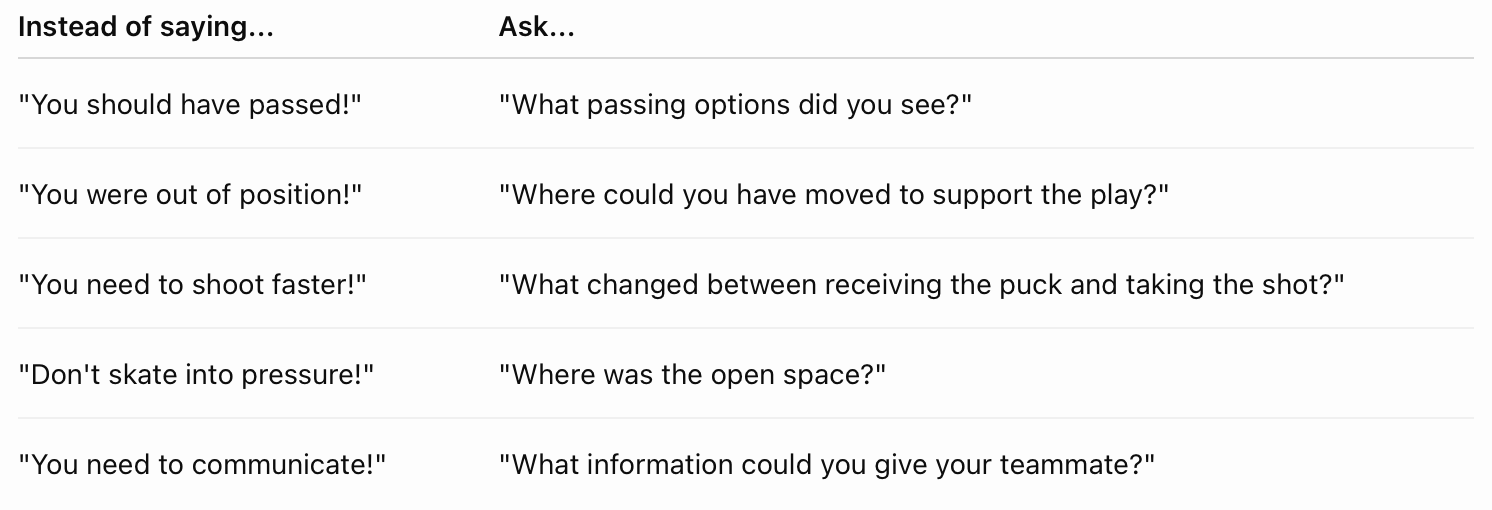
The purpose isn't to turn every coaching interaction into a lengthy conversation.
It's to help players understand the relationship between what they see, what they decide, and what happens next.
Keep Questions Age-Appropriate
For younger athletes, questions should be simple.
"Where was the open space?"
"Who could help you?"
"What did you notice?"
For older athletes, questions can become more complex.
"How did the defender's positioning influence your decision?"
"What could you have done earlier to create another passing option?"
"How might that decision change if we were protecting a one-goal lead?"
Know When to Give the Answer
Questioning is valuable, but it shouldn't replace all direct instruction.
If a player doesn't understand a concept, she may need a clear explanation or demonstration.
The goal is to balance guidance with independent thinking.
Breakaway Coaching Tip: Ask questions that help players understand the game—not questions designed to make them feel embarrassed for getting something wrong.
7. Let Players Make Mistakes
This might be one of the hardest adjustments for coaches.
We want our players to succeed.
We want them to make the right decisions.
And when we see a mistake developing, our instinct is to intervene.
But players need opportunities to make decisions, experience the consequences, and adjust.
A player who never attempts a difficult pass may avoid turnovers.
But she may also miss opportunities to develop the awareness and confidence required to execute that pass successfully in the future.
Create a Learning Environment
Players should understand that mistakes are part of development.
That doesn't mean removing accountability.
It means distinguishing between mistakes caused by a lack of effort and mistakes that occur while attempting to learn.
For example:
A player tries to make a pass through a narrow lane and turns the puck over.
Instead of immediately criticizing the decision, ask:
"What did you see?"
"Was there another option?"
"What might you try next time?"
The player may recognize that carrying the puck into open space would have created a better opportunity.
That understanding is more valuable than simply being told not to make the pass again.
Avoid Creating Fear-Based Hockey
When athletes become afraid of making mistakes, they may begin choosing the safest possible option in every situation.
They stop experimenting.
They hesitate.
They become overly dependent on instructions.
And their confidence can suffer.
Breakaway Coaching Tip: Hold players accountable for their effort, preparation, and willingness to learn. Give them room to make mistakes while developing their decision-making skills.
8. Teach Players to Anticipate the Next Play
Strong hockey players don't simply react to what's happening.
They begin recognizing what might happen next.
This ability is often described as anticipation.
For example, an effective defensive player may recognize that an opponent is preparing to pass across the ice.
Rather than chasing the puck, she adjusts her positioning to take away the passing lane.
An offensive player may recognize that her teammate is about to win a puck battle and move into open space before possession is established.
These decisions require awareness and experience.
How to Develop Anticipation
Use Game-Like Situations
Expose players to realistic patterns of movement, pressure, and transitions.
Encourage Scanning
Teach athletes to gather information before the puck arrives.
Use Video
Pause game footage before a decision and ask players what they think will happen next.
Discuss Patterns
Help athletes recognize common situations, such as forechecking pressure, defensive gaps, and support options.
Allow Repeated Exposure
Players need opportunities to experience similar situations with different outcomes.
Simple Video Exercise
Show players a short clip of a breakout.
Pause the video before the defenseman makes her decision.
Ask:
"What do you see?"
"Where is the pressure?"
"What options are available?"
"What would you do?"
Then play the clip and discuss the outcome.
Avoid presenting the actual decision as the only possible correct answer.
There may have been several effective options.
Breakaway Coaching Tip: Anticipation develops when athletes learn to recognize patterns and connect them to possible outcomes.
9. Help Players Understand the Why Behind Systems
Team systems are an important part of hockey.
But players who only memorize their assignments may struggle when situations don't unfold as expected.
Instead, teach the principles behind the system.
Example: Defensive-Zone Coverage
A coach might tell a winger:
"Stay on your point."
That's a simple instruction.
But what happens when the puck moves below the goal line?
What happens when the opposing defenseman activates into the play?
What happens when the puck is rimmed along the boards?
A player who understands only her assigned location may struggle to adapt.
Instead, explain the purpose of her responsibility.
She's helping protect dangerous scoring areas, manage passing options, and respond to changes in possession and positioning.
Now she has a reason for her movement.
Use Situational Teaching
Create scenarios that require players to recognize how their responsibilities change.
For example:
Puck moves from the corner to the point.
A defender activates below the faceoff circle.
A teammate loses possession.
An opponent moves into an open scoring area.
The defending team gains possession and begins a breakout.
Pause the activity occasionally and ask players to explain their decisions.
Breakaway Coaching Tip: Teach the system, but make sure players understand the principles that allow them to adapt when the system breaks down.
10. Build Hockey IQ Into Every Practice
Developing hockey IQ shouldn't require an entirely separate practice dedicated to classroom instruction.
It can be integrated into nearly every activity.
The key is designing practices that include opportunities for awareness, decisions, and problem-solving.
Sample 60-Minute Hockey IQ Practice
Primary Objective: Recognizing Pressure and Creating Support
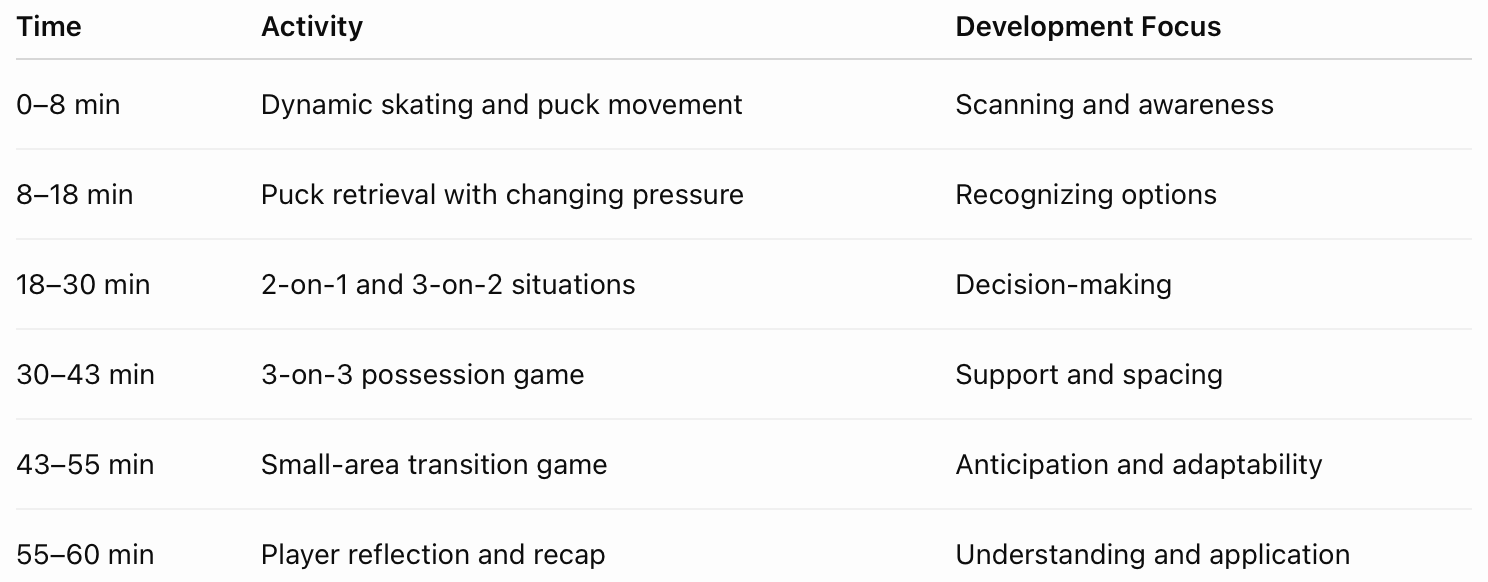
Adjust the complexity, work-to-rest periods, and physical demands to the age and ability of your group.
Coaching Objectives for the Session
Rather than focusing only on successful passes or goals, evaluate whether players are:
Looking for information before receiving the puck
Recognizing defensive pressure
Creating support options
Making decisions without constant instruction
Adjusting when situations change
Communicating with teammates
These are observable behaviors that help coaches evaluate hockey IQ development.
11. Adjust Your Approach by Age and Experience
Hockey IQ development should begin early, but the way we teach it should evolve as players grow.
8U–10U: Recognize Simple Situations
At younger ages, focus on foundational awareness and simple decisions.
Examples include:
Recognizing open space
Identifying teammates
Moving toward or away from the puck appropriately
Understanding basic offensive and defensive concepts
Making simple choices in small-area games
Keep instructions short and activities engaging.
12U–14U: Connect Decisions to Game Situations
As players gain experience, introduce more complex situations.
Examples include:
Reading defensive pressure
Recognizing passing lanes
Supporting puck carriers
Understanding numerical advantages
Adjusting positioning during transitions
Making decisions under time constraints
Encourage players to explain their thought processes.
16U–19U: Develop Advanced Game Understanding
Older and more experienced athletes should increasingly be challenged to recognize complex situations and adapt independently.
Examples include:
Reading forechecking structures
Recognizing tactical advantages
Understanding situational risk
Anticipating transitions
Adjusting to opponents
Managing game situations based on score and time
Players should also begin taking greater ownership of their preparation and evaluation.
These are broad examples, not rigid age-based expectations. Coaching decisions should always account for individual development, experience, and readiness.
12. Evaluate Hockey IQ Through Observable Behaviors
One of the challenges with hockey IQ is that it's often evaluated subjectively.
A coach may describe a player as having "good hockey sense" without explaining what that means.
But if we want athletes to improve, we need to provide specific feedback.
What Should Coaches Look For?
Awareness
Does the player recognize where teammates, opponents, and open space are located?
Scanning
Does she look for information before receiving or retrieving the puck?
Decision-Making
Does she choose appropriate options based on pressure and available space?
Support
Does she move into positions that create opportunities for teammates?
Anticipation
Does she recognize how plays are developing?
Adaptability
Does she adjust when the situation changes?
Make Feedback Specific
Instead of:
"You need to improve your hockey IQ."
Try:
"Before receiving the puck along the boards, check where the defender is so you can recognize whether you have time to turn."
Instead of:
"You need to make better decisions."
Try:
"When the defender takes away the passing lane, look for an opportunity to carry the puck into the open space."
Specific feedback gives players a clear developmental objective.
Breakaway Coaching Tip: Hockey IQ isn't a fixed label. It's a collection of abilities that can be developed through intentional coaching and experience.
13. Remember That Thinking Takes Time
Not every player develops hockey IQ at the same pace.
Some athletes recognize patterns quickly.
Others need more repetitions, demonstrations, or opportunities to experience different situations.
A player who struggles with decision-making today may become highly effective as her technical skills, confidence, and game experience develop.
Coaches should avoid permanently labeling athletes as having high or low hockey IQ.
Instead, focus on identifying what each player needs to improve.
Consider the Bigger Picture
Sometimes a player appears to make a poor decision because she lacks the skating ability to execute a better option.
Sometimes she recognizes the correct pass but doesn't have the technical confidence to attempt it.
Sometimes she's overwhelmed by the speed of the game.
And sometimes she simply hasn't experienced that situation enough times to recognize the available options.
These distinctions matter.
Effective coaching identifies the underlying challenge rather than assuming every mistake reflects a lack of understanding.
Breakaway Coaching Tip: Before criticizing a player's decision, consider whether she had the awareness, technical ability, time, and confidence needed to execute another option.
The Breakaway Standard: Develop Thinkers, Not Followers
At Breakaway Girls Hockey, we want athletes who understand the game.
Players who recognize opportunities.
Who anticipate pressure.
Who make confident decisions.
Who adapt when things don't go according to plan.
And who trust themselves enough to take ownership of what happens on the ice.
But those abilities don't develop simply because we tell players to "play smarter."
They develop through intentional coaching.
Through practices that challenge athletes to recognize information.
Through conversations that encourage them to think.
Through environments where mistakes become learning opportunities.
And through coaches who understand that their responsibility is to develop independent players—not control every decision.
The next time you're behind the bench and see a play developing, consider whether your athlete needs another instruction or another opportunity to learn.
Because the ultimate measure of hockey IQ development isn't whether players can execute a coach's instructions.
It's whether they can recognize the game, understand their options, and make effective decisions when nobody is telling them what to do.
Help Develop the Next Generation of Hockey Thinkers
Breakaway Girls Hockey is committed to supporting female coaches through education, mentorship, practical coaching resources, and leadership development.
Explore our Female Coach Development resources to learn how to create more purposeful practices, build complete players, and develop confident decision-makers.
EXPLORE COACH DEVELOPMENT RESOURCES
Her Game. Her Climb. Her Breakaway.