
Ideas, resources, and perspectives to challenge how we teach, communicate, lead, and develop athletes.
We ask our players to get better every single day.
We challenge them to work harder, learn new skills, accept feedback, and push beyond their comfort zones.
We expect them to show up prepared, take responsibility for their development, and approach every practice with a willingness to improve.
But here's a question every coach should ask themselves:
Are we holding ourselves to the same standard?
As coaches, it's easy to become so focused on developing our athletes that we forget about our own development.
We spend hours creating practice plans, preparing for games, evaluating players, communicating with parents, and managing the countless responsibilities that come with leading a team.
Somewhere along the way, our own education can become an afterthought.
But the game continues to evolve.
Athletes change. Coaching methods improve. New research challenges traditional approaches. And the expectations placed on coaches continue to grow.
The coaches who make the greatest impact aren't necessarily the ones who know the most.
They're the ones who recognize that there's always more to learn.
At Breakaway Girls Hockey, we believe that developing better athletes starts with developing better coaches.
And that development should never stop.
1. Being a Great Player Doesn't Automatically Make You a Great Coach
Many coaches begin their careers because they love hockey.
Some played at competitive levels. Others grew up around the game, volunteered with local programs, or stepped behind the bench because their community needed someone willing to help.
Every path into coaching brings valuable experiences.
But playing hockey and teaching hockey are two very different skills.
As a player, your responsibility is to understand the game and execute your role.
As a coach, your responsibility is to help other people understand, learn, and perform.
That requires an entirely different set of abilities.
Great coaches must learn how to:
Communicate clearly with different personalities
Break complicated skills into understandable concepts
Recognize individual development needs
Create effective learning environments
Manage team dynamics
Provide constructive feedback
Adapt when something isn't working
Build trust with athletes and families
A coach can have an exceptional understanding of hockey and still struggle to communicate that knowledge effectively.
And someone without an elite playing background can become an outstanding coach through preparation, education, mentorship, and experience.
Breakaway Coaching Principle: Your playing career may influence what you know about hockey. Your willingness to learn determines how effectively you teach it.
2. The Game Is Evolving. Our Coaching Should, Too.
Think about how hockey has changed over the past decade.
Players are faster. Training opportunities have expanded. Skill development has become increasingly specialized. Coaches have greater access to video, educational resources, and information about athlete development.
But perhaps one of the most important changes is how we understand learning.
Traditional coaching often relied heavily on repetition, predetermined drills, and coaches directing every decision.
Those methods still have value in certain situations, particularly when introducing technical skills.
However, modern coaching increasingly emphasizes decision-making, game-like environments, athlete engagement, and helping players solve problems independently.
Consider Two Coaching Approaches
Approach A:
A coach demonstrates a drill, explains exactly where every player should skate, and tells athletes when to pass and shoot.
Players repeat the pattern until they execute it correctly.
Approach B:
A coach introduces a game situation, provides a clear objective, and creates an environment where athletes must recognize pressure, communicate, and make decisions.
Players learn through repetition, feedback, and adapting to different outcomes.
Both approaches can serve a purpose.
But if we rely exclusively on one, we may limit the learning opportunities available to our athletes.
The challenge for coaches is understanding when each approach is appropriate.
Ask Yourself
Am I teaching this skill because it's what my players need?
Or am I teaching it because it's how I was taught?
There's nothing wrong with using familiar methods.
But familiarity shouldn't be our only reason for choosing them.
Breakaway Coaching Tip: Don't confuse experience with continued growth. Coaching for ten years doesn't automatically mean you've spent ten years improving your coaching.
3. Learn How Athletes Learn
One of the biggest opportunities for coaching development is understanding the learning process itself.
Not every athlete responds to instruction the same way.
Some players quickly understand verbal explanations.
Others benefit from demonstrations.
Some need time to practice independently before receiving feedback.
Others learn best when placed in competitive situations that allow them to discover solutions.
Effective coaches recognize these differences and adjust their approach.
Five Ways to Become a Better Teacher
1. Keep Instructions Clear
Avoid overwhelming players with too much information at once.
Focus on one or two important teaching points.
2. Demonstrate When Appropriate
Showing a skill or situation can help athletes understand what you're asking them to do.
3. Allow Time for Practice
Players need opportunities to attempt skills, make mistakes, and adjust.
4. Ask Questions
Encourage athletes to think about what they're seeing and experiencing.
5. Adapt Your Feedback
Recognize when a player needs encouragement, clarification, a new challenge, or a different explanation.
The Power of Asking Instead of Telling
Imagine a player repeatedly makes the wrong decision during a 2-on-1.
You could stop the drill and tell her exactly what she should have done.
Or you could ask:
"What did you notice about the defender's positioning?"
"What options did you have?"
"What might you try differently next time?"
Those questions help the player develop her own understanding.
The goal isn't to eliminate direct instruction.
It's to recognize that athletes also learn through exploration, decision-making, and reflection.
Breakaway Coaching Tip: The best coaches don't simply provide answers. They help athletes develop the ability to find answers themselves.
4. Communication Is One of Your Most Important Coaching Skills
You can design the perfect practice and understand every aspect of hockey strategy.
But if you can't communicate effectively with your athletes, your impact will be limited.
Communication influences how players understand expectations, respond to mistakes, build confidence, and develop trust.
And strong communication isn't simply about speaking clearly.
It's also about listening.
Communicating With Athletes
Players need to understand what you expect from them and why it matters.
Be specific.
Instead of:
"You need to work harder."
Try:
"When we lose possession, I want you to immediately move your feet and work to regain defensive position."
Instead of:
"Make better decisions."
Try:
"Before receiving the puck, look over your shoulder so you know where the pressure is coming from."
Specific feedback creates clear opportunities for improvement.
Communicating With Parents
Parents are important partners in youth hockey.
They want their daughters to succeed, feel supported, and enjoy the experience.
Clear expectations around development, team standards, communication, and playing time can help prevent misunderstandings.
Coaches should strive to be approachable while maintaining appropriate boundaries.
Communicating With Your Coaching Staff
Assistant coaches need clarity, trust, and opportunities to contribute.
A strong coaching staff shares information, discusses challenges, and works toward common objectives.
Breakaway Coaching Tip: Communication isn't about how much you say. It's about whether the people you're leading understand, trust, and can act on what you're communicating.
5. Feedback Goes Both Ways
We expect our athletes to be coachable.
We ask them to listen, apply corrections, and accept constructive feedback.
But how do we respond when someone offers feedback about our coaching?
Do we become defensive?
Do we immediately explain why our approach was correct?
Or do we take time to consider whether there might be something worth learning?
One of the most important qualities a coach can develop is the ability to receive feedback without viewing it as a personal attack.
Where Can Coaching Feedback Come From?
Other Coaches
Invite trusted colleagues to observe practices or discuss your approach.
Assistant Coaches
Encourage your staff to share ideas and identify opportunities for improvement.
Athletes
Ask players whether they understand the objectives of practice and what helps them learn.
Mentors
Seek guidance from experienced coaches who can challenge your thinking.
Self-Reflection
Review your own practices, communication, and decisions.
Questions Worth Asking Your Players
"What part of practice helped you the most today?"
"Was there anything that was confusing?"
"What situations do you want more opportunities to work on?"
"Do you understand what we're trying to improve as a team?"
Athlete feedback doesn't mean every coaching decision should be determined by a vote.
It means recognizing that the people experiencing your coaching can provide valuable information about its effectiveness.
Breakaway Coaching Tip: If we expect athletes to receive feedback with an open mind, we should be willing to model that same behavior.
6. Find Mentors Who Challenge You
Coaching can sometimes feel isolating.
You're responsible for decisions that affect athletes, families, and team performance.
And there isn't always someone standing beside you with the right answer.
That's why mentorship matters.
A good mentor can help you:
Navigate difficult coaching situations
Improve practice planning
Develop communication skills
Understand different coaching philosophies
Build leadership confidence
Reflect on challenging decisions
Identify professional development opportunities
Your Mentor Doesn't Have to Coach at the Highest Level
An effective mentor might be:
An experienced youth hockey coach
A former college player who now coaches
A respected female coach in your organization
A coach from another sport
A leader with expertise in teaching, communication, or athlete development
Different perspectives can help you become more well-rounded.
Don't Just Look for Agreement
One of the most valuable things a mentor can do is challenge your assumptions.
If everyone around you always agrees with your decisions, you may be missing opportunities to improve.
Seek people who are willing to ask thoughtful questions and offer constructive criticism.
Breakaway Coaching Tip: Surround yourself with people who want to see you succeed—and who care enough to challenge you along the way.
7. Invest in Your Coaching Education
Coaching development doesn't have to mean earning another certification every month or spending thousands of dollars attending conferences.
There are many ways to continue learning.
The key is being intentional.
Formal Coaching Education
Organizations such as USA Hockey offer coaching education programs, age-specific resources, and development opportunities.
These programs can help coaches build foundational knowledge and stay informed about current approaches.
Clinics, Workshops, and Conferences
Learning directly from other coaches can expose you to different philosophies, teaching methods, and leadership approaches.
Don't attend simply to collect drills.
Pay attention to how experienced coaches communicate, structure learning, and engage athletes.
Observe Other Coaches
Watching another coach run practice can be incredibly valuable.
Notice:
How they organize the ice
How they explain drills
How they provide feedback
How they manage transitions
How they respond to mistakes
How they create energy and engagement
Study the Game
Watch hockey with a coaching objective.
Rather than simply following the puck, focus on positioning, spacing, transitions, and decision-making.
Consider how you might teach those concepts to your athletes.
Read Beyond Hockey
Leadership, communication, education, psychology, and youth development all influence coaching effectiveness.
Some of the most valuable lessons you learn may come from outside the sport.
Breakaway Coaching Tip: Don't measure your development by how many resources you consume. Measure it by what you learn, apply, and improve.
8. Build Your Own Coaching Philosophy
Every coach has a philosophy, whether they've intentionally defined it or not.
Your philosophy influences how you run practices, communicate with athletes, manage expectations, and define success.
But have you ever taken the time to write it down?
Start With These Questions
What do I believe great coaching looks like?
Think beyond wins and losses.
What do I want my athletes to learn?
Consider technical skills, confidence, leadership, accountability, and teamwork.
What standards will I consistently uphold?
Identify the behaviors and expectations that matter most.
How do I want athletes to feel in my environment?
Challenged? Supported? Confident? Connected?
How will I measure success?
Will you focus only on results, or also on individual growth and long-term development?
A Coaching Philosophy Should Evolve
Your philosophy doesn't need to remain identical throughout your career.
As you gain experience, work with different athletes, and encounter new challenges, your perspective may change.
That's a sign of growth.
At Breakaway, our coaching philosophy emphasizes intentional development, competitive environments, confidence, hockey intelligence, and meaningful relationships.
But we also believe coaches should continually evaluate how effectively they're delivering on those principles.
Breakaway Coaching Tip: A coaching philosophy is only meaningful when your daily actions reflect it.
9. Leadership Is More Than Being in Charge
Coaching is a leadership role.
But leadership isn't defined by how loudly you speak, how many decisions you make, or how much authority you have.
It's defined by the influence you have on the people around you.
Athletes observe how coaches respond to adversity.
They notice how we treat officials, opponents, parents, and other coaches.
They pay attention to how we handle mistakes and whether we hold ourselves to the same standards we expect from them.
Model the Behaviors You Want to See
If you want players to demonstrate accountability, acknowledge your own mistakes.
If you want athletes to communicate respectfully, model respectful communication.
If you expect players to remain composed under pressure, work to demonstrate that composure yourself.
If you want your team to embrace learning, show them that you're still learning too.
Create Leaders, Not Dependence
Strong coaching doesn't mean athletes rely on you for every decision.
It means you're helping them develop the confidence and judgment to lead themselves and others.
Give players opportunities to communicate, solve problems, and take responsibility.
Breakaway Coaching Tip: The goal of leadership isn't to make everyone depend on you. It's to help others become more capable and confident.
10. Female Coaches Matter—and So Does Their Development
Girls hockey continues to create opportunities for female athletes.
But developing the game also requires investing in the women who coach, mentor, and lead those athletes.
Representation matters.
When girls see women teaching the game, leading teams, making decisions, and holding leadership positions, they see possibilities for their own futures.
But representation alone isn't enough.
Female coaches also need access to:
Quality education
Experienced mentors
Meaningful coaching opportunities
Leadership development
Professional networks
Constructive feedback
Supportive environments
Clear pathways for advancement
Creating Opportunities for the Next Generation
Experienced coaches have an opportunity to bring others into the profession.
Invite former players to help at practices.
Give young coaches ownership of drills and stations.
Encourage them to pursue coaching education.
Provide feedback and mentorship.
And create environments where their voices are valued.
A young woman who begins by helping at a youth clinic could eventually become a head coach, program director, or leader within the sport.
That journey often begins because someone gave her an opportunity.
Breakaway Coaching Principle: If we want more women leading hockey in the future, we need to invest in developing female coaches today.
11. Avoid the Trap of Coaching on Autopilot
One of the biggest challenges experienced coaches face is becoming comfortable.
You have drills you like.
Systems you trust.
Practice routines that feel familiar.
And approaches that have worked in the past.
There's nothing wrong with consistency.
But there's a difference between consistency and complacency.
Signs You May Be Coaching on Autopilot
You rarely change your practice structure.
You use drills without clearly identifying their purpose.
You rely on the same feedback for every player.
You haven't sought coaching education recently.
You rarely ask for feedback.
You measure success almost exclusively through wins and losses.
You resist new ideas because they differ from how you were taught.
These aren't reasons to feel discouraged.
They're opportunities to reflect.
Try One Change at a Time
You don't need to reinvent your coaching philosophy overnight.
Start small.
Introduce more decision-making into one drill.
Ask players a question instead of immediately giving an answer.
Observe another coach's practice.
Request feedback from an assistant.
Read about a new teaching approach and test it with your team.
Then evaluate what happened.
Breakaway Coaching Tip: Improvement doesn't always require dramatic change. Small, intentional adjustments can make a meaningful difference over time.
12. Create Your Personal Coach Development Plan
We ask athletes to set development goals.
Coaches should do the same.
A personal development plan helps turn the idea of becoming a better coach into specific action.
Step 1: Identify Your Strengths
What do you currently do well?
Maybe you're excellent at building relationships, organizing practices, teaching skating, or creating competitive environments.
Recognizing your strengths helps you understand what you can build upon.
Step 2: Identify Your Growth Areas
Where do you want to improve?
Possible areas include:
Practice planning
Technical instruction
Hockey IQ development
Communication
Conflict resolution
Team culture
Leadership
Player evaluation
Age-appropriate development
Choose two or three priorities rather than trying to improve everything at once.
Step 3: Find Learning Opportunities
Identify specific ways to develop those areas.
For example:
Goal: Improve practice efficiency.
Action: Observe two experienced coaches and evaluate how they organize stations and transitions.
Goal: Become a better communicator.
Action: Practice giving shorter, more specific feedback during drills.
Goal: Develop player decision-making.
Action: Incorporate one additional game-like activity into each practice.
Step 4: Apply What You Learn
Knowledge becomes valuable when you put it into practice.
Test new ideas and observe how your athletes respond.
Step 5: Reflect and Adjust
Set aside time every month to evaluate your progress.
What worked?
What didn't?
What would you change?
What do you want to learn next?
Sample 30-Day Coach Development Challenge
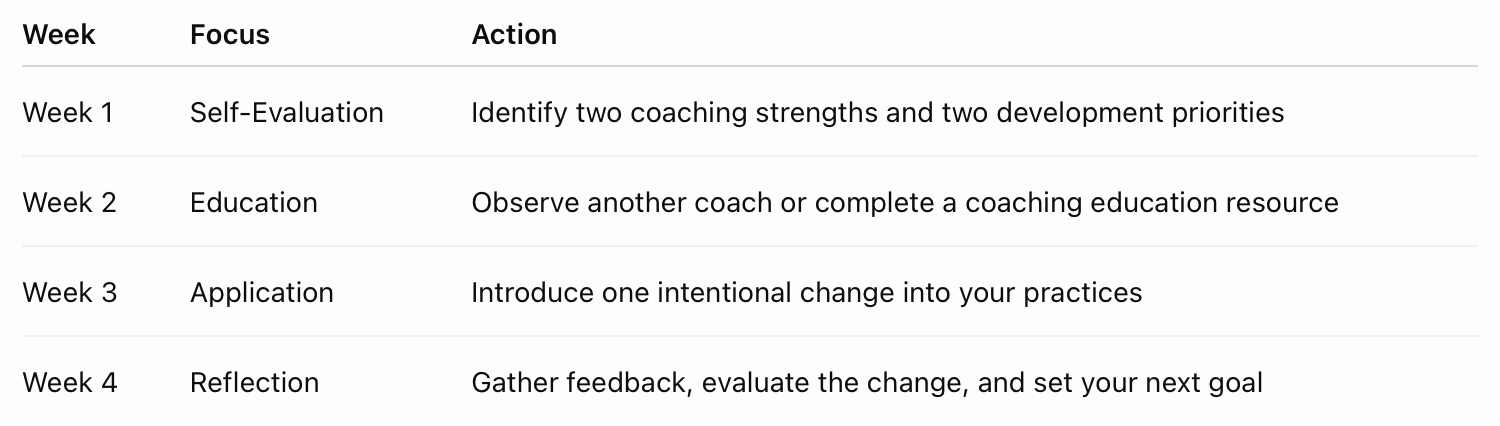
This simple process helps make coach development an ongoing habit.
13. Remember the Impact You Have
As coaches, it's easy to get caught up in the immediate demands of the season.
The next opponent.
The next practice.
The next tournament.
The next roster decision.
But our influence extends far beyond the scoreboard.
Years from now, your players may not remember every drill you ran.
They may not remember every system you taught.
They might not even remember the final score of an important game.
But they'll remember how you made them feel.
They'll remember whether you believed in them.
Whether you challenged them.
Whether you supported them through difficult moments.
Whether you helped them find confidence they didn't know they had.
And whether you made them feel like they belonged.
That's the responsibility—and the opportunity—of coaching.
The more intentional we are about developing ourselves, the better equipped we become to make that impact.
The Breakaway Standard: Never Stop Climbing
At Breakaway Girls Hockey, we believe development is a lifelong process.
That applies to the girls on the ice.
And it applies to the coaches standing behind the bench.
We want coaches who are curious.
Who ask questions.
Who challenge traditional thinking.
Who welcome feedback.
Who invest in their education.
Who support one another.
And who understand that becoming a great coach isn't a destination.
It's an ongoing commitment.
You don't have to know everything.
You don't have to have all the answers.
And you don't have to be the most experienced person in the rink.
But you should be willing to keep learning.
Because if we're going to challenge our athletes to become better every day, we owe it to them to keep developing our game, too.
Grow With Breakaway Girls Hockey
Breakaway is committed to creating meaningful opportunities for female coaches to learn, lead, connect, and develop.
Through coaching education, mentorship, practical resources, and future development opportunities, we're working to support the next generation of women behind the bench.
Whether you're an experienced head coach, a former player exploring coaching, or someone just beginning your journey, there's a place for you in the future of girls hockey.
Her Game. Her Climb. Her Breakaway.