
Leadership. Accountability. Standards. Captains. Communication. Building a team environment where players challenge and support one another.
Every coach wants a team that works hard.
A team that competes every shift, supports one another, responds to adversity, and takes pride in representing their organization.
We want players who show up prepared, hold themselves accountable, communicate effectively, and put the team's success ahead of individual recognition.
But here's the question:
Are those qualities something we simply expect from our players, or are they something we're intentionally teaching and developing?
Team culture is one of the most talked-about concepts in sports.
Coaches use phrases like "family," "buy-in," "accountability," and "team-first mentality."
We put motivational quotes on locker room walls, organize team dinners, and talk about the importance of leadership.
Those things can have value.
But they don't automatically create a strong culture.
Culture is built through the expectations we establish, the behaviors we reinforce, the relationships we develop, and the standards we consistently uphold.
It's reflected in how players treat one another when coaches aren't watching.
It's visible in how a team responds after a difficult loss.
It's revealed when a player makes a mistake, when someone isn't getting the playing time she wants, or when teammates disagree.
At Breakaway Girls Hockey, we believe great team culture doesn't happen by accident.
It's built intentionally, reinforced consistently, and owned collectively.
And as coaches, we're responsible for creating the environment where that culture can grow.
1. Understand What Team Culture Actually Means
Team culture isn't simply whether your players like each other.
A team can have strong friendships and still struggle with accountability, communication, or competitive standards.
Likewise, a team can be highly competitive without creating an environment where athletes feel supported.
A strong culture brings those elements together.
It creates a shared understanding of:
Who we are as a team
What we value
How we treat one another
What standards we expect
How we respond to challenges
What we're working toward together
Culture Is What Happens Every Day
Think about two teams.
Team A talks frequently about accountability.
But players arrive late without consequences, effort varies from practice to practice, and coaches enforce expectations differently depending on the athlete.
Team B has clear expectations.
Players understand what preparation looks like, coaches consistently reinforce standards, and teammates respectfully challenge one another when those standards aren't met.
Which team has a stronger culture?
The difference isn't necessarily talent, coaching experience, or team chemistry.
It's consistency.
Breakaway Coaching Principle: Culture isn't what you say your team believes. It's what your team consistently demonstrates.
2. Start With a Clear Team Identity
Before players can take ownership of a culture, they need to understand what they're being asked to build.
That starts with defining your team's identity.
Ask yourself:
What do we want to be known for?
Not just in terms of wins and losses, but in how we prepare, compete, communicate, and represent our organization.
Maybe your team wants to be known for relentless effort.
Maybe it's disciplined defensive hockey.
Maybe it's resilience, preparation, and supporting one another.
Whatever you choose, those qualities should guide your daily expectations.
Identify Three to Five Core Values
Avoid creating a long list of inspirational words that players struggle to remember.
Instead, select a few values that are meaningful and actionable.
For example:
Compete
We give consistent effort, engage in difficult situations, and respond when challenged.
Accountability
We take responsibility for our preparation, actions, and decisions.
Respect
We treat teammates, coaches, officials, opponents, and families with dignity.
Growth
We embrace feedback, learn from mistakes, and commit to improvement.
Team First
We recognize that our actions influence the people around us.
Make Your Values Observable
A value becomes meaningful when players understand what it looks like.
If accountability is a core value, define it.
Does it mean arriving on time?
Being prepared?
Owning mistakes?
Communicating when there's a problem?
Following through on commitments?
The more specific you are, the easier it becomes to reinforce those expectations.
Breakaway Coaching Tip: If your players can't explain what your team values look like in action, your values may need to be more clearly defined.
3. Establish Standards Before You Need to Enforce Them
One of the biggest mistakes coaches make is waiting until a problem occurs to establish an expectation.
A player repeatedly arrives late.
A teammate makes a disrespectful comment.
Someone isn't putting forth effort in practice.
Suddenly, the coach introduces a new rule.
While situations sometimes require new boundaries, a strong culture begins with clear expectations established early.
Standards vs. Rules
Rules typically define what is or isn't allowed.
Standards describe how a team commits to operating.
For example:
Rule: Players must arrive 15 minutes before practice.
Standard: We respect our teammates' time by arriving prepared and ready to contribute.
Both can be useful.
But standards help athletes understand the purpose behind expectations.
Areas Where Teams Need Clear Standards
Preparation
What does being ready for practice and games look like?
Effort
What level of engagement is expected?
Communication
How should players communicate with coaches and teammates?
Respect
How do we treat officials, opponents, and one another?
Accountability
What happens when expectations aren't met?
Team Responsibilities
What does each player contribute beyond individual performance?
Involve Players in the Process
Coaches should establish the foundational expectations, but athletes can help define how those expectations come to life.
At the beginning of the season, ask players:
"What does being a great teammate look like?"
"What behaviors should we expect from one another?"
"How should we respond when someone makes a mistake?"
"What do we want other teams to say about us?"
Use their responses to create a team standards document.
When players contribute to the process, they may feel greater ownership of the outcome.
Breakaway Coaching Tip: Standards are strongest when coaches establish clear boundaries and players understand their responsibility for upholding them.
4. Build Accountability Without Creating Fear
Accountability is essential to strong team culture.
But accountability is often misunderstood.
Some coaches associate accountability with punishment.
A player makes a mistake, so she skates.
Someone loses a drill, so the team does conditioning.
A teammate struggles, so she gets publicly criticized.
Those approaches may create immediate compliance, but they don't necessarily teach responsibility or improve performance.
Effective accountability is about helping athletes understand their responsibilities and the impact of their choices.
What Healthy Accountability Looks Like
Clear Expectations
Players know what's expected before they're evaluated.
Consistency
Standards apply fairly, regardless of skill level or status.
Ownership
Athletes are encouraged to acknowledge mistakes and take responsibility.
Constructive Feedback
Coaches explain what needs to improve and how.
Appropriate Consequences
Responses are proportionate, respectful, and connected to the behavior.
Opportunities to Improve
Players have a path forward after making a mistake.
Example: A Player Arrives Late
Instead of immediately embarrassing her in front of the team, have a conversation.
Ask what happened.
Determine whether there are circumstances that need to be considered.
Reinforce the expectation.
Discuss how she can meet it moving forward.
Repeated issues may require additional consequences, but the goal should remain developing responsibility—not simply demonstrating authority.
Accountability Should Apply to Coaches, Too
If coaches expect punctuality, they should arrive prepared.
If players are expected to communicate respectfully, coaches should model that behavior.
If athletes are asked to take ownership of mistakes, coaches should be willing to acknowledge their own.
Breakaway Coaching Principle: Accountability isn't about creating fear of failure. It's about creating ownership of actions, decisions, and improvement.
5. Develop Leaders Throughout the Roster
Leadership is one of the most valuable qualities a team can develop.
But it shouldn't be limited to the players wearing letters on their jerseys.
Captains and assistant captains play important roles.
However, every athlete should understand that she has the ability—and responsibility—to influence the team's environment.
Leadership Looks Different on Every Player
Some athletes lead through communication.
They're vocal, energetic, and comfortable encouraging others.
Others lead through their work ethic.
They arrive prepared, consistently compete, and set an example through their actions.
Some are natural relationship builders.
They notice when teammates are struggling and help others feel included.
Others bring emotional stability.
They remain composed when the team faces adversity.
These are all valuable forms of leadership.
Five Types of Leadership Worth Recognizing
The Competitive Leader
Sets the standard through effort, preparation, and intensity.
The Communication Leader
Helps teammates stay connected, informed, and focused.
The Culture Leader
Builds relationships, promotes inclusion, and reinforces team values.
The Accountability Leader
Models responsibility and respectfully challenges teammates to meet expectations.
The Resilience Leader
Helps the team respond constructively to mistakes, setbacks, and difficult moments.
A player doesn't need to be the most skilled athlete to demonstrate these qualities.
And different players may demonstrate multiple leadership strengths.
Breakaway Coaching Tip: Don't confuse leadership with popularity, seniority, or talent. Look for athletes who consistently influence the team in positive ways.
6. Make Captains More Than a Letter on a Jersey
Captains can play a meaningful role in establishing team culture.
But too often, captaincy becomes a title without clearly defined responsibilities.
A player receives a letter, takes a photo, and is expected to lead without much additional guidance.
Leadership, like hockey skills, needs to be developed.
What Should Captains Actually Do?
Depending on the age group, captains may help:
Reinforce team standards
Welcome new players
Encourage communication
Support teammates through difficult moments
Set the tone during practices
Communicate team concerns appropriately
Model preparation and accountability
Promote positive locker room behavior
Give Captains Specific Responsibilities
Rather than telling captains to "be leaders," establish clear expectations.
For example:
Before Practice
Help ensure teammates are organized, prepared, and focused.
During Practice
Demonstrate effort, communicate positively, and encourage teammates.
During Games
Support team composure and help maintain a positive bench environment.
Off the Ice
Help foster inclusion and identify concerns that may need coach attention.
Meet With Your Leadership Group
Consider holding short, regular captain meetings.
Ask:
"How is the team feeling?"
"Are there any concerns we should address?"
"What's going well with our culture?"
"Where can we improve?"
"What support do you need from the coaching staff?"
These conversations help captains develop communication, reflection, and leadership skills.
Remember: Captains Are Still Developing Athletes
Captains will make mistakes.
They may struggle with difficult conversations or feel pressure to have all the answers.
Coaches should mentor them rather than expecting them to manage serious conflicts, discipline teammates, or carry adult responsibilities.
Breakaway Coaching Tip: Don't just appoint captains. Teach them how to lead.
7. Create an Environment Where Players Feel They Belong
Belonging is an essential part of a healthy team culture.
Players are more likely to engage positively when they feel respected, included, and connected to the people around them.
But belonging doesn't happen automatically.
Especially in girls hockey, where athletes may come from different organizations, schools, communities, or playing backgrounds.
Some players may already know one another.
Others may be joining a team where they don't have established friendships.
Coaches need to be intentional about creating connections.
Ways to Build Belonging
Welcome New Players
Make introductions and establish a clear process for helping new athletes become part of the group.
Mix Up Groups
Avoid allowing the same friendship circles to dominate every practice activity or team exercise.
Create Shared Experiences
Use appropriate team activities, challenges, and traditions to build relationships.
Recognize Different Contributions
Celebrate players for leadership, improvement, effort, and support—not only scoring.
Address Exclusion Early
Pay attention to locker room dynamics, cliques, and patterns of disrespect.
Belonging Doesn't Mean Everyone Has to Be Best Friends
Players won't always have the same personalities or interests.
They may disagree.
They may compete for roles or playing time.
That's normal.
The goal isn't to force friendships.
It's to establish an environment where every athlete is treated with respect and has a meaningful place on the team.
Breakaway Coaching Principle: Every girl deserves to feel that she belongs, regardless of her skill level, personality, or role.
8. Teach Teammates How to Challenge and Support One Another
One of the strongest signs of a healthy team culture is when players begin reinforcing standards without constant intervention from coaches.
But this requires teaching athletes how to communicate constructively.
There's a difference between holding a teammate accountable and criticizing her.
Constructive Teammate Communication
Instead of:
"You're not working hard enough!"
Try:
"Come on, we've got another rep. Let's finish strong."
Instead of:
"Why did you make that pass?"
Try:
"I was open on the other side. Let's look for that next time."
Instead of:
"You messed that up!"
Try:
"We've got you. Let's get the next one."
These examples reinforce accountability while maintaining respect.
Teach Players to Separate Behavior From Identity
A teammate can make a poor decision without being a bad player.
She can have a difficult practice without lacking commitment.
She can struggle in a game without deserving ridicule.
Coaches should reinforce language that focuses on actions and improvement.
Address Negative Behavior Consistently
Sarcasm, exclusion, personal insults, and repeated disrespect shouldn't be dismissed as normal competitive behavior.
Athletes need to know that high standards and mutual respect can coexist.
Breakaway Coaching Tip: The strongest teams don't avoid difficult conversations. They learn how to have them respectfully.
9. Build Trust Through Consistent Communication
Trust is a foundation of strong team culture.
Players need to believe that coaches are acting in their best interests, applying expectations fairly, and communicating honestly.
That doesn't mean every athlete will agree with every decision.
Playing time, roster roles, line combinations, and competitive expectations can create disappointment.
But coaches can build trust through clarity and consistency.
Communicate Expectations Early
Explain:
How roles are determined
What influences playing time
What standards are expected
How players can ask for feedback
How concerns should be addressed
What development opportunities are available
Have Difficult Conversations Privately
When a player is struggling, avoid unnecessary public criticism.
Give specific feedback and explain what she can work on.
For example:
"Right now, we're looking for more consistent defensive positioning and quicker puck decisions. Let's focus on those areas over the next few practices."
That gives the athlete direction.
Listen Without Promising Agreement
Players should feel comfortable asking questions and expressing concerns.
Listening doesn't mean the coach must change every decision.
It means taking the athlete seriously and explaining the reasoning when appropriate.
Breakaway Coaching Tip: Trust grows when athletes know what to expect from you—even when the conversation is difficult.
10. Define How Your Team Responds to Adversity
Every team faces adversity.
Losing streaks.
Injuries.
Disappointing performances.
Roster changes.
Difficult tournament weekends.
Conflicts between teammates.
Those moments reveal the strength of a team's culture.
A strong culture doesn't prevent adversity.
It helps athletes respond to it constructively.
Establish a Response Standard
Teach players to focus on three things:
1. Acknowledge What Happened
Recognize mistakes and challenges without assigning unnecessary blame.
2. Identify What Can Be Controlled
Focus on preparation, effort, communication, and execution.
3. Take the Next Step
Determine what needs to improve and move forward.
Example: After a Difficult Loss
Instead of delivering a long emotional speech, ask:
"What did we do well?"
"Where did we struggle?"
"What can we control moving forward?"
"What needs to change at our next practice?"
Give players an opportunity to reflect.
Then establish a clear path forward.
Avoid Making Every Loss a Crisis
Not every loss indicates a culture problem.
Sometimes teams lose because the opponent is stronger.
Sometimes players are learning.
Sometimes execution simply isn't good enough.
Coaches should evaluate performance without allowing every result to redefine the team's identity.
Breakaway Coaching Tip: Resilience isn't pretending disappointment doesn't matter. It's learning how to respond to disappointment productively.
11. Create Traditions That Reinforce Your Values
Team traditions can be powerful tools for building connection.
But the best traditions reinforce something meaningful.
They shouldn't exist simply because another team does them.
Examples of Purposeful Team Traditions
Teammate Recognition
After practice or games, allow players to recognize someone who demonstrated effort, leadership, or support.
Leadership Moments
Give different players opportunities to lead warm-ups, team discussions, or appropriate activities.
Team Service Projects
Participate in community initiatives that connect athletes to something beyond competition.
New Player Welcome
Create a tradition that helps new athletes feel included from their first day.
Development Recognition
Celebrate improvements in confidence, skills, work ethic, and teamwork.
Make Traditions Inclusive
Avoid traditions that embarrass players, require significant family spending, or pressure athletes into activities they're uncomfortable with.
The goal should be connection—not conformity.
Breakaway Coaching Tip: The best team traditions aren't necessarily the biggest or most expensive. They're the ones that consistently reinforce who you want to be.
12. Understand the Role of Parents in Team Culture
Parents are an important part of the youth hockey environment.
Their communication, expectations, and behavior can influence the experiences of their daughters and the broader team.
Coaches should establish clear communication with families early.
Set Parent Expectations
Discuss topics such as:
Respectful communication
Appropriate game-day behavior
Supporting athlete independence
Understanding development priorities
Navigating playing-time concerns
Maintaining positive relationships with other families
Encourage Parents to Support the Process
A parent's role isn't to coach every shift from the stands.
It's to support their daughter's development, encourage effort, and help maintain a healthy relationship with the game.
Coaches can reinforce this by communicating the team's developmental priorities and providing appropriate opportunities for questions.
Address Issues Professionally
When concerns arise, establish a clear process for communication.
Avoid emotionally charged conversations immediately after games whenever possible.
Protect player privacy and handle individual concerns directly with the appropriate family.
Breakaway Coaching Tip: A healthy team culture includes clear boundaries and respectful partnerships between coaches, athletes, and families.
13. Evaluate Your Culture Throughout the Season
Culture isn't something you establish during the first team meeting and revisit only when problems arise.
It needs consistent attention.
Just as coaches evaluate skating, puck skills, and tactical execution, we should evaluate the environment we're creating.
Five Questions to Ask Yourself
1. Do our players understand our standards?
Can they explain what the team values and how those values appear in daily behavior?
2. Are expectations applied consistently?
Do the same standards apply to every athlete?
3. Do players feel respected and included?
Are there signs of exclusion, disrespect, or unhealthy team dynamics?
4. Are players taking ownership?
Do athletes reinforce positive behaviors and accept responsibility?
5. Are we modeling the culture we expect?
Do our actions as coaches reflect our stated values?
Use Team Check-Ins
Consider periodic conversations with players.
Ask:
"What are we doing well as a team?"
"Where could we improve?"
"Do you feel supported by your teammates?"
"What would make our team environment stronger?"
For sensitive concerns, provide a private, age-appropriate way for athletes to communicate with a trusted adult. Don't rely on team discussions or anonymous surveys alone to identify serious problems.
Respond to What You Learn
Collecting feedback is only useful if coaches are willing to act on it.
If athletes identify a recurring issue, evaluate it thoughtfully and communicate appropriate next steps.
Breakaway Coaching Tip: Culture is something you maintain through consistent attention, not something you achieve once and assume will last.
14. A Practical Team Culture Framework
If you're building a new team or trying to improve an existing environment, start with a simple process.
Step 1: Define Your Identity
Identify three to five core values.
Explain what each looks like in action.
Step 2: Establish Standards
Set expectations for preparation, effort, communication, respect, and accountability.
Step 3: Involve Your Players
Give athletes age-appropriate opportunities to contribute to team expectations and traditions.
Step 4: Develop Leaders
Identify different leadership strengths and provide opportunities for growth.
Step 5: Reinforce the Culture Daily
Recognize behaviors that reflect your values.
Address behaviors that undermine them.
Step 6: Evaluate and Adjust
Gather feedback, reflect on team dynamics, and make improvements throughout the season.
Sample 30-Day Team Culture Plan
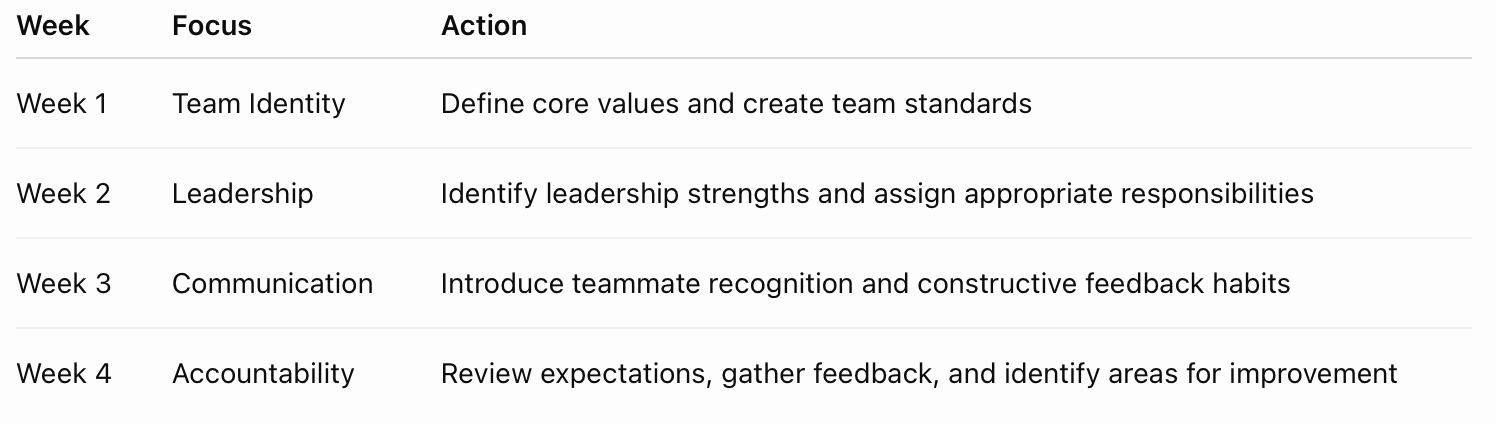
This framework can be adapted for teams of different ages and competitive levels.
The important part is creating consistent habits rather than relying on one-time activities.
15. Remember What Players Will Carry With Them
One day, every athlete will play her final game.
Some will continue into college hockey.
Others may become coaches, officials, mentors, or leaders within the sport.
Some may pursue completely different paths.
But the experiences they have within their teams can influence how they approach challenges, relationships, and leadership long after they stop playing.
They'll remember the coaches who believed in them.
The teammates who supported them.
The moments when they overcame adversity together.
The standards they learned to uphold.
And the feeling of being part of something meaningful.
That's why team culture matters.
We're not simply building teams that can win hockey games.
We're helping young athletes learn how to contribute to a community, take responsibility, communicate effectively, and support the people around them.
Those lessons extend far beyond the rink.
The Breakaway Standard: Build Something Worth Belonging To
At Breakaway Girls Hockey, we believe strong teams are built through more than talent.
They're built through trust.
Accountability.
Leadership.
Respect.
Communication.
Shared expectations.
And a genuine commitment to one another.
We want athletes who challenge each other to improve.
Who celebrate one another's successes.
Who respond to adversity together.
Who understand that every player has value.
And who take pride in the culture they're helping create.
But those qualities don't develop simply because a coach tells players to be a family.
They develop through daily actions.
Through consistent standards.
Through difficult conversations handled with respect.
Through opportunities for leadership.
And through coaches who understand that building people is just as important as building hockey players.
The strongest team cultures aren't built around making every player the same. They're built around giving every player a meaningful reason to contribute.
Because years from now, the wins and losses may fade.
But the experience of being part of something special can stay with an athlete for a lifetime.
Build a team players are proud to represent. Build an environment where they feel challenged and supported. Build something they want to be part of.
Build Stronger Teams With Breakaway
Breakaway Girls Hockey is committed to supporting female coaches through education, mentorship, leadership development, and practical coaching resources.
Explore our Female Coach Development library for more resources on practice planning, player development, hockey IQ, communication, and building positive competitive environments.
EXPLORE COACH DEVELOPMENT RESOURCES
Her Game. Her Climb. Her Breakaway.