
Skating. Skills. Hockey IQ. Decision-making. Compete. Confidence. Learn how to build development into everything you do.
Every hockey coach wants to develop better players.
We spend hours designing practices, teaching skills, correcting mistakes, and preparing our teams for competition.
We work on skating mechanics, passing accuracy, shooting technique, defensive positioning, and offensive systems.
But here's a question every coach should consider:
Are we teaching our athletes how to execute hockey skills, or are we developing players who know how to use those skills?
There's a difference.
A player might have excellent skating technique but struggle to create separation during a game.
She might have an incredible shot but rarely recognize when to use it.
She might dominate drills in practice but hesitate when a defender applies pressure.
And she might understand exactly what her coach wants but lack the confidence to make decisions independently.
These aren't necessarily problems that can be solved by adding more drills.
They're reminders that hockey development is multidimensional.
At Breakaway Girls Hockey, we believe the best coaches develop the complete player: an athlete who combines technical ability, hockey intelligence, competitive habits, confidence, and the willingness to keep learning.
That philosophy should influence everything we do on the ice.
1. What Does It Mean to Develop the Complete Player?
A complete hockey player isn't someone who has mastered every skill.
It's someone who is continually developing the ability to combine different skills and apply them effectively in the game.
Think about the difference between these two players.
Player A has excellent stickhandling skills. She can move through cones quickly, execute complicated puck-handling patterns, and perform advanced moves during warm-ups.
But when she enters a game, she struggles to recognize pressure, loses possession frequently, and hesitates to make decisions.
Player B may not have the same technical ability, but she recognizes open space, supports her teammates, makes effective decisions, and competes consistently.
Which player is more effective?
The answer depends on the situation, but the comparison highlights something important.
Technical ability alone doesn't determine performance.
A complete player learns to connect several areas of development:
Skating: Moving efficiently, changing direction, and creating or closing space.
Technical Skills: Handling, passing, receiving, shooting, and protecting the puck.
Hockey IQ: Recognizing patterns, anticipating situations, and understanding the game.
Decision-Making: Choosing effective actions under pressure.
Compete Level: Engaging consistently and responding to challenges.
Confidence: Trusting preparation and being willing to take appropriate risks.
Coachability: Applying feedback and taking ownership of improvement.
These areas aren't independent.
They influence one another constantly.
Breakaway Coaching Principle: The goal isn't to develop athletes who can perform skills in isolation. It's to develop athletes who can use their abilities effectively when the game demands it.
2. Skating: Develop Movement That Translates to the Game
Skating is the foundation of hockey performance.
But skating development should go beyond speed tests and repetitive laps.
Players need to skate in ways that help them solve problems during games.
That means developing the ability to:
Accelerate into open space
Change direction while maintaining balance
Transition between forward and backward movement
Use edges to create separation
Adjust speed based on the situation
Maintain stability while handling the puck or absorbing legal contact
Teach Skating With a Purpose
Consider a traditional edgework drill.
Players skate through a series of cones, focusing on inside and outside edges.
This can be valuable for developing mechanics.
But how does that skill translate to a game?
Try progressing the drill.
Phase 1: Technical Execution
Players practice the edgework pattern without pressure.
Phase 2: Puck Integration
Players complete the same movement while controlling a puck.
Phase 3: Decision-Making
Players react to a coach's signal or visual cue that determines their next direction.
Phase 4: Game Application
Players use their edges to escape pressure from a defender in a confined space.
Now the skating skill has a clear purpose.
The athlete isn't just learning how to move.
She's learning when and why that movement matters.
Breakaway Coaching Tip: Whenever possible, connect skating mechanics to a realistic hockey situation. Players should understand how the movement helps them become more effective.
3. Technical Skills: Quality Matters More Than Complexity
There is a tendency in hockey development to associate advanced training with complicated drills.
More cones. More movements. More elaborate stickhandling patterns.
But complexity doesn't always create better players.
A player who can execute a simple skill consistently at game speed may be more effective than someone who performs an impressive move only in a controlled environment.
Technical development should focus on:
Consistency: Can the player execute the skill repeatedly with proper technique?
Speed: Can she perform the skill efficiently without unnecessary movements?
Adaptability: Can she execute it in different positions, directions, and situations?
Pressure: Can she maintain control when an opponent challenges her?
Decision-Making: Does she recognize when the skill is appropriate?
Example: Developing Passing Skills
A traditional passing drill might involve two players passing back and forth while stationary.
That can help introduce proper technique.
But games rarely provide stationary, uncontested passing opportunities.
Progress the activity by asking players to:
Pass while moving.
Receive passes from different angles.
Make passes while changing direction.
Identify multiple passing options.
Execute passes with defensive pressure.
Apply the skill during a small-area game.
Each progression introduces a new challenge.
Breakaway Coaching Tip: Before adding complexity, ask whether the activity improves a skill players actually need during competition.
4. Hockey IQ: Teach Players to Read the Game
Hockey IQ is often described as something athletes naturally possess.
Some players seem to anticipate the play before it happens.
They recognize passing lanes, move into open space, and consistently make effective decisions.
But hockey IQ isn't simply an inherited ability.
Coaches can help players develop game understanding through intentional teaching and experience.
What Are We Actually Teaching?
Hockey IQ includes the ability to recognize:
Where pressure is coming from
Where open space exists
Where teammates and opponents are positioned
How a play is developing
What options are available
How a decision might influence the next play
Teach Players to Scan
One of the most valuable habits coaches can reinforce is looking for information before receiving the puck.
For example, a player skating toward a loose puck should be encouraged to identify:
Where her teammates are
Whether a defender is approaching
What space is available
What she might do after gaining possession
This habit can help players make decisions more efficiently.
Use Questions to Develop Understanding
Instead of always telling players what they should have done, ask questions.
"What did you see before you received the puck?"
"Where was the pressure coming from?"
"What other options were available?"
"Why did you choose to carry the puck instead of passing?"
These conversations encourage athletes to process the game rather than simply memorize instructions.
Breakaway Coaching Tip: Hockey IQ develops when players have opportunities to recognize situations, make decisions, and learn from the outcomes.
5. Decision-Making: Give Players Ownership of the Game
One of the biggest differences between practice and competition is unpredictability.
In a drill, players often know exactly what's going to happen.
They know where to skate, who to pass to, and when to shoot.
In a game, those decisions change constantly.
If we want players to become effective decision-makers, they need opportunities to practice making decisions.
Closed Drills vs. Open Drills
Closed drills involve predetermined movements and outcomes.
For example, a player skates around a cone, passes to a teammate, receives the puck back, and takes a shot.
These drills can be useful for introducing technique.
Open drills require players to respond to changing information.
For example, a player enters the offensive zone with two passing options and must decide whether to shoot, pass, or carry based on a defender's positioning.
Both types of activities have value.
But as athletes develop, coaches should increasingly incorporate situations that require perception, decision-making, and adaptation.
Avoid Coaching Every Decision
It's tempting to shout instructions throughout a drill or game.
"Pass!"
"Shoot!"
"Turn!"
"Go wide!"
But when coaches make every decision for their athletes, players may become dependent on external instructions.
Instead, create environments where athletes have to recognize the situation themselves.
Allow them to make mistakes.
Then help them understand the outcome.
Breakaway Coaching Tip: Our responsibility isn't to make every decision for our players. It's to help them develop the ability to make effective decisions independently.
6. Compete Level: Develop Habits, Not Just Intensity
Compete level is one of the most commonly used phrases in hockey.
Coaches talk about wanting players who work hard, battle for pucks, and bring energy to every shift.
But compete level should be more than a vague expectation.
It should be something we intentionally develop.
What Does Compete Level Look Like?
Compete level includes:
Pursuing loose pucks
Maintaining effort through a difficult drill
Responding after losing possession
Working to regain defensive position
Protecting the puck under pressure
Supporting teammates
Staying engaged away from the puck
Continuing to work when a situation becomes challenging
How Do We Coach It?
Create competitive environments with clear expectations.
For example, during a 1-on-1 puck battle, don't simply reward the player who wins possession.
Recognize the habits that contribute to success.
Did she establish strong body position?
Did she keep her feet moving?
Did she react quickly after losing the puck?
Did she continue competing through the entire repetition?
These details help athletes understand what effective competition looks like.
Compete Level Isn't the Same as Aggression
Not every athlete expresses competitiveness in the same way.
Some players are naturally vocal and energetic.
Others are quieter but consistently engaged.
Coaches should evaluate compete level through observable behaviors rather than personality.
Breakaway Coaching Tip: Don't just demand that players compete harder. Teach them the habits and decisions that make them effective competitors.
7. Confidence: Create an Environment Where Players Can Grow
Confidence is one of the most powerful influences on player performance.
An athlete may possess the technical ability to execute a skill but hesitate because she's afraid of making a mistake.
That hesitation can affect every aspect of her game.
She may pass instead of carrying the puck.
Avoid taking a shot.
Stop attempting new skills.
Or become overly cautious when competing against stronger opponents.
How Coaches Influence Confidence
Confidence is shaped by the experiences athletes have in their training environment.
Coaches can support confidence by:
Providing clear expectations
Recognizing effort and improvement
Offering constructive feedback
Creating achievable challenges
Allowing mistakes during learning
Encouraging players to try new things
Avoiding unnecessary public criticism
Giving athletes opportunities to take ownership
Challenge Without Discouraging
Development requires athletes to experience difficulty.
If every drill is easy, players may not be challenged enough to improve.
But if every activity feels impossible, confidence and engagement can suffer.
Effective coaching finds an appropriate balance.
Athletes should experience success while also being challenged to stretch beyond their current abilities.
Breakaway Coaching Tip: Confidence doesn't come from telling athletes they're perfect. It grows when they recognize their progress and learn that they can work through challenges.
8. Coachability: Help Athletes Become Active Learners
Coachability is often described as a player's willingness to listen.
But true coachability goes further.
It's the ability to receive information, reflect, make adjustments, and take ownership of development.
A coachable player doesn't simply nod when receiving feedback.
She attempts to apply it.
How to Develop Coachability
Explain the purpose of corrections.
Help players understand why an adjustment matters.
Encourage questions.
Create an environment where athletes feel comfortable asking for clarification.
Recognize improvement.
Acknowledge when players apply feedback, even if the execution isn't perfect.
Teach reflection.
Ask players what they noticed and what they might change.
Model coachability yourself.
Be willing to acknowledge mistakes, listen to feedback, and adjust your coaching approach.
Remember: Players Learn Differently
Some athletes respond well to verbal explanations.
Others benefit from demonstrations, visual cues, or opportunities to practice the movement.
Being coachable doesn't mean every athlete processes instruction in the same way.
Breakaway Coaching Tip: Great coaching requires adaptability from both the athlete and the coach.
9. Connect Every Development Area Through Practice
The real value of complete-player development comes from integrating these skills rather than treating them as separate categories.
A well-designed activity can develop multiple areas simultaneously.
Example: 2-on-2 Corner Battle to Net
Setup
Create a confined playing area in one corner of the offensive zone with two offensive players and two defenders.
A coach initiates play by placing a puck into the corner.
The offensive team attempts to gain possession, create space, and generate a scoring opportunity.
The defending team attempts to regain possession and move the puck to a designated exit.
What Are We Developing?
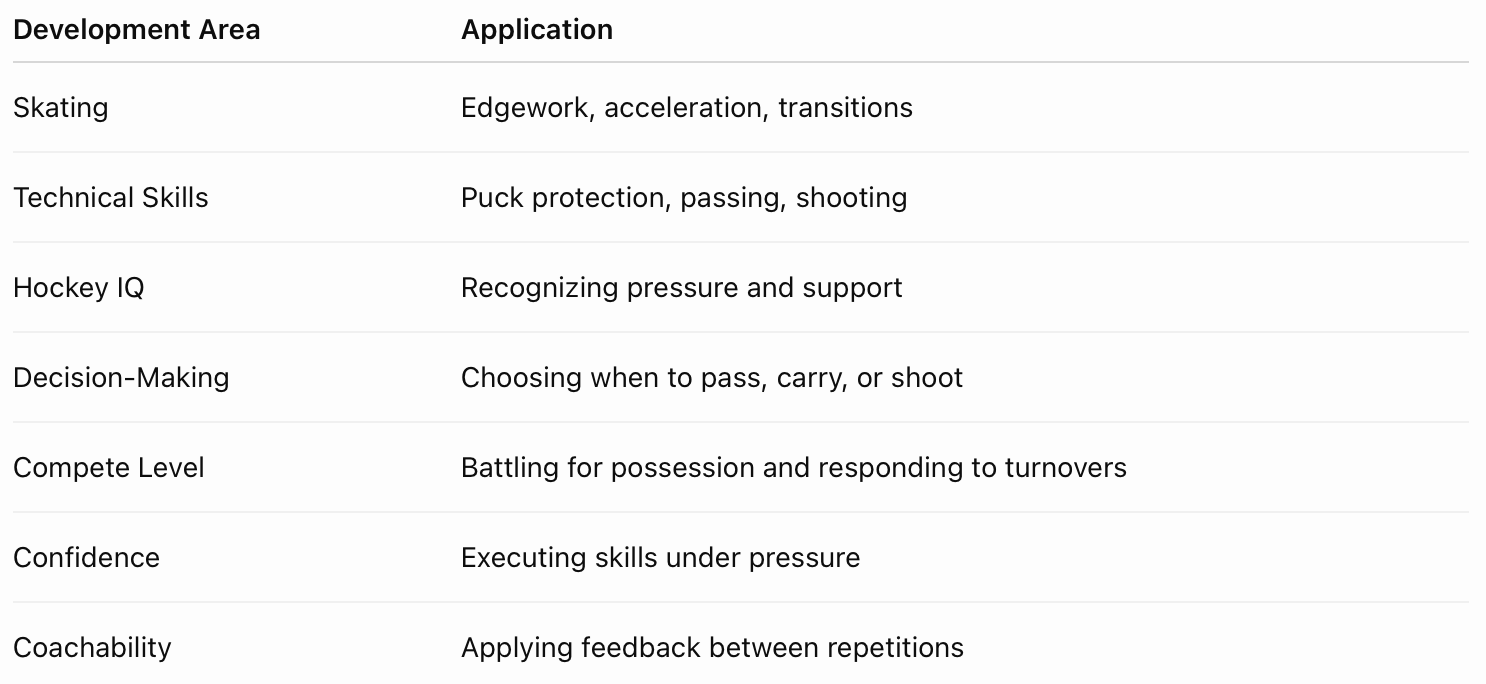
One activity can reinforce nearly every component of player development.
Coaching Progressions
Progression 1: Begin with more space and moderate defensive pressure.
Progression 2: Reduce the playing area to increase decision-making speed.
Progression 3: Introduce a time limit for generating a scoring opportunity.
Progression 4: Allow immediate transitions when defenders regain possession.
Each progression increases the challenge while maintaining the same developmental objective.
Breakaway Coaching Tip: The best activities don't necessarily teach more skills. They create better opportunities for athletes to connect and apply the skills they're learning.
10. Adapt Development to the Athlete's Stage
A complete-player philosophy applies to every age group.
But the way we coach it should change as athletes develop.
8U–10U: Build the Foundation
At younger ages, the emphasis should be on enjoyment, fundamental movement, puck familiarity, and confidence.
Priorities may include:
Skating balance and coordination
Basic puck handling
Simple passing and receiving
Small-area games
Learning to share space and cooperate
Building a positive relationship with hockey
Keep instructions simple and participation high.
12U–14U: Connect Skills to the Game
As athletes gain experience, coaches can introduce more complex decisions and competitive situations.
Priorities may include:
Executing skills at higher speeds
Reading pressure
Developing puck support
Understanding offensive and defensive responsibilities
Making decisions in small-area games
Building consistent competitive habits
This is an important stage for helping players understand why they make certain decisions.
16U–19U: Develop Consistency and Adaptability
Older and more experienced athletes should increasingly be challenged to execute skills under realistic pressure.
Priorities may include:
Advanced decision-making
Situational awareness
Tactical understanding
Position-specific responsibilities
Competitive consistency
Leadership and communication
Independent preparation and reflection
At this stage, athletes should become increasingly involved in identifying their own development priorities.
These are broad developmental examples, not rigid age-based standards. Individual maturity, experience, and readiness should always guide coaching decisions.
11. Evaluate the Complete Player, Not Just the Scoreboard
One of the challenges in youth hockey is that performance is often measured through statistics.
Goals.
Assists.
Wins.
Save percentage.
These numbers can provide useful information, but they don't tell the entire story.
A player may make excellent defensive decisions without recording a point.
Another may create scoring opportunities through effective puck support.
A developing athlete may demonstrate significant improvement in confidence, compete level, or decision-making without that progress appearing on a scoresheet.
What Should Coaches Evaluate?
Consider using a broader development framework.
Technical Development
Is the player improving her skating, puck skills, and execution?
Game Understanding
Does she recognize situations and make effective decisions?
Competitive Habits
Does she consistently engage, respond to challenges, and support her teammates?
Confidence and Independence
Is she willing to take appropriate risks and make decisions?
Coachability and Growth
Does she apply feedback and take ownership of improvement?
Make Feedback Actionable
Instead of telling a player:
"You need to improve your hockey IQ."
Try:
"Before receiving the puck, work on checking where your teammates and defenders are so you can recognize your next option sooner."
Instead of:
"You need to compete harder."
Try:
"After losing possession, focus on immediately moving your feet to regain defensive position."
Specific feedback gives athletes something they can actually work on.
Breakaway Coaching Tip: Player evaluations should provide direction, not simply assign labels.
12. The Complete Player Development Framework
Coaches can use a simple framework to keep development intentional.
Step 1: Identify the Need
What is the athlete struggling with?
Is it a technical limitation, a decision-making challenge, a confidence issue, or a combination?
Step 2: Define the Objective
What specific improvement are you trying to create?
For example: improving puck decisions under defensive pressure.
Step 3: Design the Environment
What practice activity will help the player experience and solve that challenge?
Step 4: Add Appropriate Pressure
How can the activity progress toward a more realistic game situation?
Step 5: Provide Feedback
What information will help the player recognize improvement opportunities?
Step 6: Evaluate Progress
Is the athlete beginning to apply the skill more effectively in practice and games?
This process can be repeated throughout the season.
The objective isn't to solve every developmental need immediately.
It's to create a consistent approach to improvement.
13. The Coach's Role in Long-Term Development
As coaches, we often focus on what our players need to accomplish this week.
The next practice.
The next tournament.
The next opponent.
The next playoff game.
Those things matter.
But youth hockey development is bigger than a single season.
A player who struggles at 12U may become a highly effective athlete at 16U.
A player who lacks confidence today may become a leader tomorrow.
And a girl who isn't the most skilled player on her current team may develop qualities that make her an exceptional teammate, coach, or mentor in the future.
Our responsibility is to recognize potential, provide appropriate challenges, and help athletes continue moving forward.
That requires patience.
It requires consistency.
And it requires a willingness to look beyond immediate results.
Breakaway Coaching Principle: Don't sacrifice long-term development for short-term performance.
The Breakaway Standard: Develop the Athlete, Not Just the Skill
At Breakaway Girls Hockey, we believe player development should be intentional, challenging, and centered on the individual.
We want athletes who skate with purpose.
Who understand the game.
Who make confident decisions.
Who compete consistently.
Who support their teammates.
And who are willing to learn, adapt, and grow.
But we also recognize that those qualities don't develop automatically.
They are influenced by the environments we create, the feedback we provide, and the opportunities we give athletes to challenge themselves.
That's what complete-player development is about.
Not creating perfect players.
Not expecting every athlete to follow the same path.
And not measuring success exclusively through goals, wins, or team selections.
It's about helping every girl become a more capable, confident, intelligent, and resilient hockey player—one practice, one decision, and one opportunity at a time.
Grow as a Coach With Breakaway
Breakaway Girls Hockey is committed to developing the next generation of female hockey coaches through education, mentorship, practical resources, and leadership opportunities.
Explore our Female Coach Development resources to continue building your coaching knowledge and creating meaningful development experiences for your athletes.
EXPLORE COACH DEVELOPMENT RESOURCES
Her Game. Her Climb. Her Breakaway.