
Maximize ice time, keep players engaged, and connect every drill to the game.
Every hockey coach has experienced it.
You arrive at the rink with a practice plan, a handful of drills, and a list of things your team needs to improve.
But 20 minutes into practice, things aren't going the way you imagined.
Players are standing in lines. A drill takes longer to explain than it does to execute. The pace drops. Your athletes lose focus. And suddenly, you're halfway through your ice time without accomplishing what you intended.
Sound familiar?
The difference between an average practice and a great one isn't necessarily the complexity of the drills or the experience of the coach.
It's the intention behind the practice.
At Breakaway Girls Hockey, we believe great coaching starts long before players step onto the ice. It starts with understanding your athletes, identifying what they need, and designing an environment where every minute has purpose.
Whether you're coaching 8U beginners or competitive 19U athletes, the principles of effective practice planning remain remarkably consistent.
Let's break down how to build practices that are organized, engaging, competitive, and designed for real development.
1. Start With the Why, Not the Drill
One of the most common mistakes coaches make is planning practice by collecting drills.
You find a skating drill you like, add a passing drill you've used before, throw in a shooting exercise, and finish with a scrimmage.
You have a practice plan.
But do you have a development objective?
Before choosing a single drill, ask yourself:
What do I want my players to be better at when they leave the ice today?
Maybe your team struggles to move the puck quickly through the neutral zone.
Maybe players hesitate to make decisions under pressure.
Maybe your younger athletes need more confidence with their edges and puck control.
Those observations should determine your practice—not the other way around.
Choose One Primary Objective
Every practice should have a clear developmental focus.
Examples include:
Improving puck support and passing decisions
Developing skating acceleration and edge control
Winning puck battles and maintaining possession
Creating offense through movement and spacing
Improving defensive positioning and transitions
Building confidence under pressure
You can reinforce multiple skills throughout a practice, but one primary objective helps create consistency.
For example, if your focus is puck support, that theme should appear in your warm-up, skill work, competitive drills, and small-area games.
Breakaway Coaching Tip: Don't ask, "What drills should I run today?" Ask, "What problem am I trying to help my players solve?"
2. Maximize Repetitions, Minimize Standing Around
Ice time is one of the most valuable resources in youth hockey.
And one of the easiest ways to waste it is by having players spend too much time standing in lines.
Imagine two drills.
In the first, 12 players stand in one line, waiting for their turn to skate through cones and take a shot.
In the second, those same 12 players are divided among three stations, each working on a related skill.
The second setup generally creates more opportunities to practice, receive feedback, and improve.
How to Increase Player Engagement
Use multiple stations. Divide the ice into smaller areas where players can work simultaneously.
Keep lines short. When possible, aim for no more than three or four players waiting at a station.
Build in continuous movement. Design drills so athletes can rotate efficiently without stopping the entire group.
Use both ends of the ice. Mirror drills when appropriate to increase participation.
Plan transitions. Know where players and equipment need to go before the next drill begins.
A Simple Coaching Exercise
During your next practice, watch one player for five minutes.
How much time does she spend actively participating?
How much time does she spend waiting?
You may be surprised by the answer.
Breakaway Coaching Tip: More repetitions don't automatically mean better development. The goal is frequent, high-quality repetitions with meaningful feedback and appropriate challenge.
3. Build Practices Around Game-Like Situations
Technical skill development is essential.
Players need opportunities to practice skating, passing, shooting, and puck handling in controlled environments.
But hockey isn't played against cones.
It's played against opponents who are constantly moving, applying pressure, and making decisions.
That's why effective practices should progress beyond isolated skills.
The Skill-to-Game Progression
A useful framework is:
Step 1: Introduce the Skill
Give players an opportunity to understand and practice the movement or technique.
For example, receiving a pass while moving.
Step 2: Add a Decision
Introduce a choice that requires players to recognize information.
For example, deciding between passing to a teammate or carrying the puck into space.
Step 3: Add Pressure
Introduce a defender, time constraint, or limited playing area.
Now players must execute the skill while responding to an opponent.
Step 4: Apply It in a Game
Use a small-area game or situational competition where the skill naturally appears.
This progression helps players understand not just how to execute a skill, but when and why to use it.
Example: Developing Puck Support
Instead of spending an entire practice on passing lines, you might:
Begin with passing and receiving while moving.
Progress into a two-player support drill with multiple passing options.
Add a defender to create pressure.
Finish with a 3-on-3 small-area game emphasizing support and puck possession.
The same developmental theme runs through the entire practice.
Breakaway Coaching Tip: The more closely a practice situation reflects the decisions players face in games, the more opportunities they have to develop transferable hockey skills.
4. Use Small-Area Games to Develop Hockey IQ
Small-area games are among the most versatile tools a hockey coach can use.
By reducing the playing surface and adjusting the number of players, coaches can create situations that encourage frequent puck touches, quick decisions, and competitive engagement.
Small-area games can help develop:
Puck protection
Spatial awareness
Passing and support
Quick transitions
Defensive positioning
Creativity
Communication
Compete level
Example: 3-on-3 Possession Game
Setup: Create a confined playing area with two teams of three players.
Objective: Maintain possession while moving to create passing options.
Possible Rule: A team must complete three passes before attempting to score.
Coaching Focus: Players should move into open space, support the puck carrier, and make decisions under pressure.
Progression: Remove the passing requirement and challenge players to recognize scoring opportunities naturally.
The important part isn't the specific game.
It's how the coach uses the environment to teach.
Ask Questions Instead of Providing Every Answer
During a coaching pause, try asking:
"Where could you move to give your teammate another option?"
"What happened when everyone moved toward the puck?"
"What could you do differently when pressure arrives?"
These questions encourage athletes to recognize patterns and become more independent decision-makers.
Breakaway Coaching Tip: Small-area games should be designed around a specific objective. Simply playing 3-on-3 isn't automatically effective coaching.
5. Keep the Pace High Without Sacrificing Teaching
A fast-paced practice doesn't mean players should be skating nonstop for an hour.
It means practice has energy, efficient transitions, and purposeful activity.
There is a difference between a practice that is physically exhausting and one that is developmentally productive.
A well-designed practice creates opportunities for both.
Five Ways to Maintain Practice Tempo
1. Explain drills briefly.
Use clear, simple instructions. Demonstrate when necessary, then get players moving.
2. Avoid unnecessary stoppages.
Not every mistake requires stopping the entire group. Sometimes individual feedback is more effective.
3. Prepare equipment ahead of time.
Have cones, pucks, nets, and station layouts ready whenever possible.
4. Use assistant coaches strategically.
Give each coach a clear role before practice begins.
5. Adjust when something isn't working.
If a drill is confusing, too easy, or too difficult, make a change.
Don't continue running something ineffective simply because it's written on your practice plan.
When Should You Stop a Drill?
A good rule is to stop when the teaching opportunity is worth the interruption.
If the same mistake is occurring repeatedly, a brief correction may help.
If players are learning through trial and error, allow them opportunities to work through the situation.
Breakaway Coaching Tip: Great coaches know when to teach, when to challenge, and when to let the game become the teacher.
6. Make Every Player Feel Involved
One of the most important responsibilities of a coach is creating an environment where every athlete has an opportunity to develop.
This can be challenging when a team includes players with different skill levels, confidence levels, or learning needs.
A drill that's challenging for one player may be overwhelming for another.
A drill that's appropriate for a developing athlete may not challenge an advanced player.
The solution isn't necessarily separating players for the entire practice.
It's learning how to adapt.
Ways to Differentiate Practice
Adjust the space. Give developing players more room and advanced players less time and space.
Adjust the pressure. Begin with passive defenders and progress to active competition.
Adjust the objective. Challenge advanced players to execute a skill at greater speed or with additional decisions.
Create appropriate groupings. Use flexible groups based on the objective rather than permanently labeling athletes by ability.
Celebrate individual progress. Recognize improvement relative to each player's starting point.
At Breakaway, we believe every athlete deserves to be seen, challenged, and supported.
That philosophy should be reflected in how coaches organize their practices.
Breakaway Coaching Tip: Equal development opportunities don't always mean identical drills. Effective coaching meets players where they are while helping them progress.
7. Plan for Competition and Confidence
Hockey is competitive by nature.
Players need opportunities to battle, respond to pressure, and perform when situations become challenging.
But competition should be purposeful.
Not every drill needs a winner and loser, and not every mistake should result in a consequence.
Instead, use competition to reinforce the skills you're teaching.
Examples of Purposeful Competition
Puck Protection Battles
Players compete to maintain possession in a confined area.
Focus: Body positioning, balance, and protecting the puck.
Transition Races
Players respond to a signal, change direction, and accelerate into a new situation.
Focus: Reaction time, skating transitions, and quick decisions.
Small-Area Scoring Challenges
Teams compete in short games with specific objectives.
Focus: Creating offense, supporting teammates, and responding to pressure.
Confidence Matters Too
Competition should challenge athletes without making them afraid to fail.
Players need to feel comfortable attempting new skills, making mistakes, and learning from the experience.
A positive environment doesn't mean lowering expectations.
It means holding athletes to high standards while giving them the support and opportunity to improve.
Breakaway Coaching Tip: Challenge the player without diminishing the person. The best competitive environments combine accountability, encouragement, and respect.
8. Build a Practice Plan That Actually Works
A practice plan doesn't need to be complicated.
It needs to be organized, flexible, and connected to your objectives.
Here's an example of how a coach might structure a 60-minute practice.
Sample 60-Minute Hockey Practice
Primary Objective: Puck Support and Decision-Making
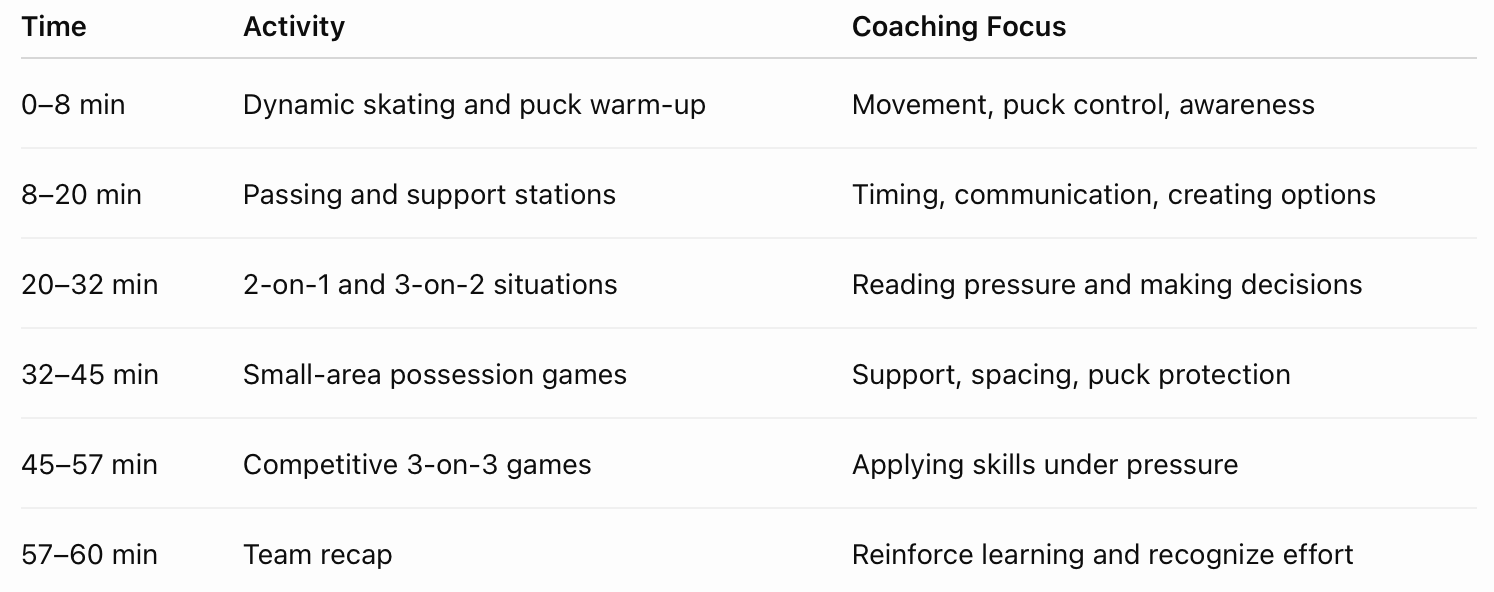
This is an illustrative framework for an appropriate youth or competitive group, not a universal plan. Adjust drill complexity, work-to-rest ratios, and instruction to your players' ages, abilities, and available ice space.
What Makes This Practice Effective?
Every activity reinforces the same primary objective.
Players begin with fundamental movements, progress into increasingly challenging situations, and finish by applying what they've learned in competition.
The practice includes technical skill development, decision-making, and game-like pressure.
Most importantly, the coach has a clear purpose for each segment.
9. Use Your Coaching Staff Effectively
Assistant coaches shouldn't arrive at the rink wondering what they're supposed to do.
A coordinated coaching staff can significantly improve practice quality.
Before practice, communicate:
The primary development objective
The drills and station assignments
Key teaching points
Equipment requirements
Transition responsibilities
Any individual player development priorities
If you're running three stations, each coach should understand what success looks like at their station.
For example:
Coach 1: Skating and Puck Control
Focus on mechanics, body positioning, and execution.
Coach 2: Passing and Decision-Making
Focus on awareness, timing, and creating options.
Coach 3: Competitive Situations
Focus on applying skills under pressure.
Developing New Coaches
This approach is particularly valuable when mentoring younger or less-experienced coaches.
Giving coaches ownership of a station helps them build confidence, practice communication, and develop their teaching abilities.
After practice, take a few minutes to discuss what worked and what could improve.
Breakaway Coaching Tip: Building better practices also means building better coaches. Give your staff opportunities to lead, learn, and grow.
10. Evaluate the Practice, Not Just the Players
Coaches spend a lot of time evaluating athletes.
But how often do we evaluate ourselves?
After each practice, take a few minutes to reflect.
Ask yourself:
Did we accomplish our primary objective?
Did the activities reinforce the skills we wanted to develop?
Were players actively engaged?
Were there unnecessary lines, delays, or confusing transitions?
Was the level of challenge appropriate?
Did players have opportunities to succeed, struggle, and improve?
Did I provide effective feedback?
Was my instruction clear, constructive, and useful?
What would I change next time?
Was there a drill that could be improved, shortened, or replaced?
You don't need a lengthy evaluation report.
A few notes after each practice can help you become more intentional and effective over time.
The Breakaway Three-Question Practice Review
After every practice, write down:
What worked?
What didn't?
What will I change next time?
Consistency with this simple habit can make a meaningful difference in your development as a coach.
11. Common Practice Planning Mistakes to Avoid
Even experienced coaches can fall into habits that limit practice effectiveness.
Here are some common mistakes worth watching for.
Too many drills. Constantly changing activities can create confusion and waste time. A few well-designed drills may be more effective than eight unrelated ones.
Long explanations. Players learn by doing. Keep instructions concise and allow athletes to experience the activity.
Too much standing around. Shorten lines, use stations, and maximize active participation.
No connection to game situations. Help players understand when and why a skill matters.
Making every drill a conditioning exercise. Physical intensity is valuable, but technical quality and decision-making also need attention.
Ignoring individual development needs. Recognize that athletes progress at different rates and may require different challenges.
Being unwilling to adjust. The practice plan is a guide, not a contract. Adapt when necessary.
Failing to communicate with assistant coaches. A prepared coaching staff creates a more organized learning environment.
12. The Breakaway Philosophy: Coach With Purpose
At Breakaway Girls Hockey, we believe great coaching is about more than knowing the game.
It's about understanding how athletes learn.
It's about creating environments where girls feel confident enough to take risks, supported enough to make mistakes, and challenged enough to continue improving.
It's about teaching players to think, compete, communicate, and make decisions for themselves.
And it's about recognizing that every practice is an opportunity to influence more than hockey skills.
You're helping develop confidence.
You're teaching accountability.
You're creating relationships.
You're showing athletes what leadership looks like.
Those lessons extend far beyond the rink.
The Bottom Line: Better Practices Create Better Opportunities
The best practice isn't necessarily the one with the most complicated drills, the highest intensity, or the most impressive-looking setup.
It's the one where players are engaged, challenged, learning, and developing skills they can apply in real situations.
As coaches, we have a responsibility to make the most of the time we're given with our athletes.
That starts with planning intentionally.
It continues with teaching effectively.
And it grows through our willingness to keep learning ourselves.
Because better practices don't just develop better hockey players. They help develop more confident athletes, stronger teams, and better coaches.
Keep Growing as a Coach With Breakaway
Breakaway Girls Hockey is committed to supporting female coaches through education, mentorship, leadership opportunities, and practical coaching resources.
Whether you're stepping behind the bench for the first time or looking to take your coaching to the next level, we're building a community where coaches can continue learning, growing, and making an impact.
Explore Breakaway Coach Development & Resources
Her Game. Her Climb. Her Breakaway.