
Communication. Confidence. Team dynamics. Leadership. Learn how to create an environment where female athletes can thrive.
Every athlete who steps onto the ice brings something different.
Different experiences.
Different personalities.
Different strengths.
Different challenges.
Different reasons for playing hockey.
Some girls arrive at practice overflowing with confidence. They're vocal, competitive, and eager to take on new challenges.
Others are quieter. They may be equally talented and motivated but need more time to build trust, find their voice, or feel comfortable taking risks.
Some thrive on direct feedback.
Others respond better when coaches explain the reasoning behind a correction.
Some are motivated by competition.
Others are driven by personal improvement, relationships, or the simple enjoyment of playing the game.
And those differences can exist within the same team, the same age group, and even among athletes with similar playing experience.
The challenge for coaches isn't figuring out how to coach girls as though they're all the same. It's learning how to coach the individual athletes standing in front of us.
At Breakaway Girls Hockey, we believe developing strong female athletes starts with understanding who they are, what motivates them, how they learn, and what they need from their coaches.
Because great coaching goes beyond teaching hockey.
It's about building trust, creating confidence, establishing meaningful relationships, and developing environments where girls feel both challenged and supported.
1. Coach the Athlete, Not the Stereotype
One of the biggest mistakes coaches can make is assuming all girls need to be coached differently simply because they're female.
You may hear statements like:
"Girls need more encouragement."
"Girls take criticism more personally."
"Boys are naturally more competitive."
"Girls care more about relationships than winning."
These generalizations may reflect someone's personal experiences, but they aren't reliable descriptions of every athlete.
Girls can be fiercely competitive.
They can respond well to direct feedback.
They can thrive under pressure.
They can be outspoken leaders.
And they can have vastly different personalities, learning preferences, and motivations.
The same is true of athletes of any gender.
What Should Coaches Focus On Instead?
Start by understanding the individual.
Ask yourself:
What motivates this player?
How does she respond to challenges?
What type of feedback helps her improve?
How confident is she in different situations?
What are her development goals?
How does she interact with teammates?
What support does she need from me?
These questions are more useful than making assumptions based on gender.
Get to Know Your Players
At the beginning of a season, consider asking athletes to complete a short questionnaire.
Questions might include:
What do you love most about hockey?
What's one thing you want to improve this season?
What helps you feel confident on the ice?
How do you prefer to receive feedback?
What's something you'd like your coaches to know about you?
The answers can provide valuable insight into how to support each player.
Breakaway Coaching Principle: The best coaches don't assume they understand an athlete because of her age, gender, or skill level. They take the time to get to know her.
2. Build Trust Before Expecting Buy-In
Trust is one of the most important foundations of a strong coach-athlete relationship.
Players are more likely to engage with coaching when they believe their coach is knowledgeable, consistent, fair, and genuinely invested in their development.
But trust isn't created through a single motivational speech.
It's developed through repeated interactions.
What Builds Trust?
Consistency
Players understand what to expect from you.
Your standards don't change dramatically based on your mood or the outcome of a game.
Fairness
Athletes know expectations are applied consistently, even when individual development needs and team roles differ.
Honesty
You communicate clearly about performance, expectations, and opportunities.
Respect
You treat athletes with dignity, including when they're struggling or making mistakes.
Follow-Through
When you make a commitment, you do your best to honor it.
Genuine Interest
You recognize players as people, not simply as positions on a roster.
Small Interactions Matter
A coach doesn't need to have a lengthy personal conversation with every athlete at every practice.
Sometimes trust grows through simple actions.
Greeting a player when she arrives.
Remembering a development goal she shared.
Recognizing improvement.
Following up after a difficult game.
Taking a question seriously.
These moments communicate that the athlete matters.
Trust Doesn't Mean Lowering Standards
A supportive coach can still be demanding.
In fact, high expectations are often more effective when athletes understand that those expectations come from a commitment to their development.
Breakaway Coaching Tip: Players don't need coaches who always tell them what they want to hear. They need coaches who are honest, consistent, respectful, and invested in helping them improve.
3. Understand How Confidence Develops
Confidence is a major component of athletic performance.
But confidence isn't simply a personality trait.
It can change depending on the situation, the athlete's preparation, previous experiences, and the environment around her.
A player may feel extremely confident during practice but hesitate in games.
Another may be comfortable competing against familiar opponents but struggle when facing a stronger team.
A younger athlete may have excellent technical ability but feel uncertain about taking risks.
Confidence Is Built Through Experience
Coaches can support confidence by creating opportunities for athletes to:
Develop skills through consistent practice
Experience appropriate challenges
Recognize their improvement
Make decisions independently
Learn from mistakes
Receive specific, constructive feedback
Contribute meaningfully to the team
Be Specific With Encouragement
Instead of saying:
"Good job!"
Try:
"Your edgework helped you create separation from the defender."
Instead of:
"Be more confident!"
Try:
"You recognized the open lane. Next time, trust that read and attack the space."
Specific feedback helps athletes understand what they did well and what they can repeat.
Don't Confuse Confidence With Loudness
Some of the most confident athletes are quiet.
They may not be the first to speak during a team meeting or celebrate loudly after a goal.
But they demonstrate confidence through preparation, decision-making, and consistent effort.
Evaluate confidence through behavior rather than personality.
Breakaway Coaching Tip: Confidence grows when athletes develop competence, recognize progress, and learn they can respond to challenges—not simply when coaches tell them to believe in themselves.
4. Learn How to Communicate With Different Personalities
Communication is one of the most important skills a coach can develop.
And one of the biggest challenges is recognizing that the same message may be received differently by different athletes.
Some players appreciate concise, direct feedback.
Others benefit from a demonstration or additional explanation.
Some are comfortable asking questions immediately.
Others may prefer a private conversation.
Four Principles of Effective Communication
1. Be Clear
Explain exactly what you're asking the player to improve.
Avoid vague statements such as "play smarter" or "work harder."
2. Be Constructive
Focus on the behavior or skill, not the athlete's identity.
3. Be Consistent
Maintain expectations and standards across the team.
4. Be Adaptable
Adjust how you communicate when your message isn't being understood.
Example: Correcting Defensive Positioning
Instead of:
"You're always out of position!"
Try:
"When the puck moves below the goal line, check your positioning so you're protecting the dangerous scoring area."
The second statement identifies the situation and provides a specific action.
Ask Players What Helps Them Learn
Coaches don't need to guess every athlete's preferences.
Ask.
"Does it help when I demonstrate the movement?"
"Would you rather talk through that situation or watch it on video?"
"Was that explanation clear?"
These conversations help players become active participants in their development.
Breakaway Coaching Tip: Effective communication isn't about delivering the same message to every player. It's about ensuring every player understands what she needs to improve.
5. Challenge Athletes Without Creating Fear of Failure
Girls hockey is competitive.
And it should be.
Athletes deserve environments that challenge them physically, mentally, and emotionally in age-appropriate ways.
They should be expected to work hard, compete, demonstrate accountability, and respond to adversity.
But there is a difference between challenging an athlete and making her afraid to fail.
What Happens When Players Fear Mistakes?
They may become hesitant.
Avoid difficult decisions.
Stop experimenting with new skills.
Rely too heavily on instructions.
Or focus more on avoiding criticism than improving.
A player who is afraid of making a turnover may pass the puck immediately, even when she has space to carry it.
A player worried about being criticized may avoid attempting a new skill.
These behaviors can limit development.
Create a Challenging but Supportive Environment
Set High Expectations
Make it clear that effort, preparation, and engagement matter.
Normalize Learning Mistakes
Help athletes understand that mistakes are part of skill development.
Separate Effort From Execution
A player can make a poor decision while still demonstrating strong effort.
Provide a Path Forward
After a mistake, help the athlete identify what she can change.
Recognize Appropriate Risk-Taking
Encourage players to attempt skills and decisions that contribute to growth.
Accountability Still Matters
Supporting athletes doesn't mean eliminating consequences.
Disrespect, unsafe behavior, repeated lack of preparation, and other conduct issues may require intervention.
The key is responding fairly and constructively.
Breakaway Coaching Principle: Create an environment where athletes are challenged to improve without being afraid to learn.
6. Recognize the Importance of Team Relationships
For many athletes, teammates are an important part of why they continue playing sports.
Friendships, shared experiences, and a sense of belonging can contribute to a positive hockey experience.
But coaches shouldn't assume every girl prioritizes relationships in the same way.
Some are highly motivated by competition.
Others value personal development.
Many appreciate a combination of achievement, friendship, and enjoyment.
The goal is to build a team environment that supports all of those motivations.
Create Meaningful Connections
Mix Practice Groups
Give athletes opportunities to work with different teammates.
Build Shared Experiences
Use appropriate team activities and traditions to strengthen relationships.
Recognize Contributions
Celebrate leadership, effort, improvement, and teamwork.
Address Exclusion
Pay attention to cliques, disrespect, and players who may be struggling to connect.
Encourage Team Ownership
Give athletes opportunities to contribute to team standards and activities.
Belonging Doesn't Require Everyone to Be Best Friends
Players may have different interests and personalities.
They may disagree or compete for positions.
That's normal.
What matters is establishing mutual respect and ensuring every athlete feels valued as a member of the team.
Breakaway Coaching Tip: Strong relationships support development, but coaches must also ensure that team dynamics don't undermine individual confidence or opportunity.
7. Understand the Challenges Girls May Experience in Hockey
Girls hockey continues to grow, but many female athletes still encounter challenges that influence their experiences in the sport.
Depending on their community and playing history, these may include:
Limited access to girls-only teams or development opportunities
Long travel distances to appropriate competition
Fewer female coaches or mentors
Limited visibility of advanced playing pathways
Differences in resources between programs
Pressure associated with team selection or recruiting
Social expectations about girls participating in competitive sports
Not every athlete experiences these challenges.
But coaches should understand the broader environment in which girls hockey operates.
Why Representation Matters
Seeing female coaches, officials, college players, and professional athletes can help girls recognize possibilities for their own futures.
A young player who sees a woman leading a team may begin to imagine herself in that role someday.
Representation isn't a substitute for quality coaching.
But it can be an important part of creating opportunity and belonging.
Build Connections Beyond Your Team
Help athletes learn about:
Girls hockey programs and development opportunities
College and club hockey pathways
Female coaching and officiating opportunities
Mentorship programs
Community events
Opportunities to remain involved in hockey beyond playing
Breakaway Coaching Principle: Supporting girls hockey means helping athletes see opportunities beyond their current team, season, or level of competition.
8. Be Thoughtful About Body Image, Physical Development, and Confidence
Youth athletes experience significant physical changes as they grow.
For girls, puberty and adolescence may influence coordination, strength, endurance, confidence, and how comfortable they feel in their bodies.
These changes don't happen at the same age or pace for every athlete.
Coaches should avoid making assumptions about an athlete's physical development based on her age or appearance.
Focus on Performance and Well-Being
When discussing physical development, emphasize:
Strength
Movement quality
Skating mechanics
Recovery
Fueling for activity
Injury prevention
Overall health and well-being
Avoid unnecessary comments about weight, body shape, or appearance.
Recognize Individual Development Timelines
An athlete experiencing a growth spurt may temporarily struggle with coordination or movement patterns.
Another may develop strength or speed at a different pace.
Coaches should adapt training expectations and avoid interpreting every physical change as a lack of effort.
Know Your Role
Coaches can promote healthy habits and supportive environments.
But medical concerns, nutrition-related conditions, and significant emotional or physical changes should be addressed by appropriately qualified professionals.
Breakaway Coaching Tip: Help athletes appreciate what their bodies can do—not how their bodies compare with someone else's.
9. Develop Leadership Opportunities for Every Girl
Leadership development is an important part of coaching.
But leadership shouldn't be limited to the most talented, oldest, or most outspoken players.
Girls demonstrate leadership in many different ways.
Some lead through communication.
Others through preparation.
Some build relationships.
Others remain composed during adversity.
Create Opportunities to Practice Leadership
Rotate Appropriate Responsibilities
Allow different athletes to lead warm-ups, organize equipment, or facilitate team activities.
Encourage Communication
Give players opportunities to speak during team discussions.
Recognize Leadership Behaviors
Highlight athletes who demonstrate accountability, support, and initiative.
Mentor Captains
Help formal leaders develop communication, decision-making, and conflict-resolution skills.
Support Quiet Leaders
Recognize athletes whose influence may be less visible but equally meaningful.
Leadership Is a Skill
A player who struggles to speak in front of teammates today may become a confident leader with encouragement and experience.
Coaches should provide development opportunities rather than assuming leadership ability is fixed.
Breakaway Coaching Tip: Don't wait for girls to demonstrate perfect leadership before giving them opportunities to lead.
10. Recognize When an Athlete Is Struggling
Coaches often spend significant time with their athletes.
That can put us in a position to notice changes in behavior, engagement, or performance.
A player who is usually enthusiastic may become withdrawn.
Another may appear unusually frustrated or anxious.
Someone may begin missing practices or struggling to connect with teammates.
These changes can have many explanations.
They don't automatically indicate a serious problem.
But they may be worth paying attention to.
How Coaches Can Respond
Check In Privately
Ask a simple, open-ended question.
"I've noticed you seem a little quieter lately. How are things going?"
Listen Without Judgment
Give the athlete an opportunity to share what she's comfortable discussing.
Avoid Making Assumptions
Don't immediately conclude that the issue is motivation, attitude, or commitment.
Maintain Appropriate Boundaries
Coaches are not therapists or medical professionals.
Involve the Right Adults
Follow organizational safeguarding policies and involve parents, guardians, designated safeguarding personnel, or qualified professionals when appropriate.
Protect Athlete Safety
If a player reports bullying, abuse, harassment, or another safety concern, take it seriously and follow applicable reporting and safeguarding procedures.
Don't promise secrecy or attempt to investigate serious allegations independently.
Breakaway Coaching Tip: You don't need to have every answer. Sometimes the most important thing a coach can do is notice, listen, and connect an athlete with appropriate support.
11. Build a Healthy Relationship With Parents
Parents and guardians are important partners in youth hockey.
They influence transportation, schedules, financial commitments, emotional support, and many aspects of the athlete's experience.
Coaches should establish clear communication and appropriate boundaries with families.
Communicate Your Coaching Philosophy
Help parents understand:
What your team values
How players will be developed
What expectations exist
How feedback is provided
How roles and playing time are determined
How concerns should be communicated
Encourage Athlete Independence
As players mature, encourage them to take an increasingly active role in their own development.
For example, an older athlete may be encouraged to speak with her coach about a development goal before a parent intervenes.
That conversation should remain age-appropriate and consistent with safeguarding requirements.
Maintain Professional Boundaries
Use approved communication channels.
Follow organizational policies regarding interactions with minors.
Keep parents informed appropriately.
And address concerns respectfully.
Breakaway Coaching Tip: Strong relationships with families can support athlete development when everyone understands their role and shares a commitment to the player's well-being.
12. Adapt Your Coaching to Different Developmental Stages
Coaching an 8U athlete is different from coaching a 19U athlete.
But age alone doesn't determine what a player needs.
Experience, maturity, confidence, and individual development should guide your approach.
8U–10U: Build Enjoyment and Belonging
At younger ages, prioritize:
Positive experiences
Fundamental skating and puck skills
Simple instructions
Frequent participation
Confidence through achievable challenges
Learning to cooperate with teammates
Enjoyment of the game
Create an environment where girls feel excited to return to the rink.
12U–14U: Support Growth and Independence
As athletes develop, coaches can place greater emphasis on:
Skill development under pressure
Decision-making
Communication
Personal accountability
Confidence during physical and social changes
Healthy team relationships
Learning to respond to adversity
This can be an important period for developing independence and ownership.
16U–19U: Prepare Athletes for Greater Responsibility
Older athletes may benefit from:
Advanced technical and tactical development
Independent preparation
Leadership opportunities
Honest performance feedback
Goal setting
Understanding future hockey pathways
Managing competitive expectations
Developing resilience and self-advocacy
Coaches should increasingly involve athletes in discussions about their development.
These are broad developmental examples rather than rigid age-based rules. Individual readiness should always guide coaching decisions.
13. Create a Coaching Environment Where Girls Can Thrive
Understanding your athletes is important.
But that understanding needs to influence how you coach.
A strong environment doesn't happen through one motivational speech or team-building activity.
It's reflected in everyday interactions.
The Breakaway Athlete Experience
At Breakaway, we believe every girl should have the opportunity to experience six things.
1. Be Seen
Every athlete deserves to be recognized as an individual with unique strengths, goals, and development needs.
2. Be Challenged
Players deserve high expectations, meaningful instruction, and opportunities to improve.
3. Belong
Every athlete should feel respected and included within the team environment.
4. Have Direction
Players should understand what they're working toward and how they can continue developing.
5. Build Relationships
Hockey should create opportunities for positive connections with teammates, coaches, and mentors.
6. Leave Better
Every experience should contribute something meaningful to an athlete's development, confidence, or relationship with the game.
These principles aren't limited to one age group or competitive level.
They can guide how we coach athletes throughout their hockey journeys.
Breakaway Coaching Principle: Every Girl. Every Stage. Every Opportunity.
14. Five Questions Every Coach Should Ask
Understanding athletes requires ongoing attention.
Before your next practice, consider these five questions.
1. Do I Know What Motivates My Players?
Can you identify what drives each athlete beyond simply wanting to win?
2. Am I Communicating Effectively?
Are your players receiving feedback they can understand and apply?
3. Does Every Athlete Feel Valued?
Are you recognizing contributions beyond goals, assists, and playing time?
4. Am I Creating Opportunities for Confidence?
Do players have room to make decisions, take appropriate risks, and learn from mistakes?
5. Am I Adapting My Coaching?
When an approach isn't working, are you willing to change how you teach?
These questions can help coaches identify opportunities for improvement.
15. A Practical Athlete Understanding Framework
Coaches can use a simple process to better understand and support their players.
Step 1: Learn About the Athlete
Ask about her goals, motivations, strengths, and challenges.
Step 2: Observe Her in Different Situations
Notice how she responds during practices, games, competition, and feedback.
Step 3: Identify Development Needs
Consider technical skills, confidence, communication, decision-making, and team engagement.
Step 4: Adapt Your Approach
Adjust instruction, feedback, challenge, or support based on what you observe.
Step 5: Check In
Ask whether the approach is helping.
Step 6: Reevaluate
Recognize that athletes change throughout a season.
What worked in September may need to evolve by January.
Sample Athlete Check-In Questions
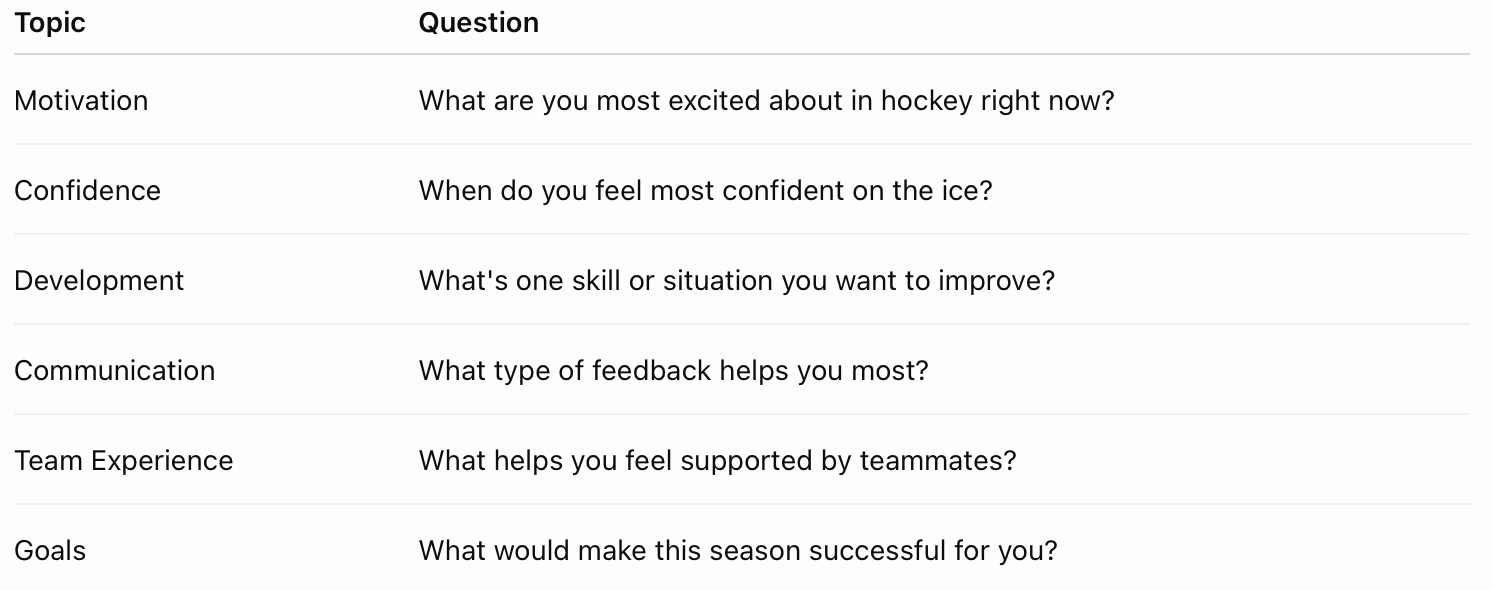
Use these conversations to inform your coaching—not to permanently categorize players.
16. Remember the Influence You Have
Coaching is a responsibility that extends beyond the ice.
The way we communicate, challenge, encourage, and support athletes can influence how they experience hockey and how they view themselves.
A coach may be the first person to help a girl recognize her leadership potential.
The first to encourage her to take a risk.
The first to show her that mistakes don't define her.
Or the first to make her feel like she truly belongs in a competitive environment.
Those experiences matter.
Not because coaches should become the center of an athlete's world.
But because we have an opportunity to contribute positively to her development.
And that opportunity deserves intentional effort.
The Breakaway Standard: See the Girl Behind the Jersey
At Breakaway Girls Hockey, we believe developing female athletes starts with understanding the individual.
Not every girl will have the same goals.
Not every athlete will respond to the same coaching style.
Not every player will develop at the same pace.
And not every girl will measure success in the same way.
Our responsibility is to recognize those differences while maintaining high standards, providing meaningful opportunities, and creating environments where athletes can continue growing.
We want girls who are confident.
Who compete.
Who communicate.
Who support one another.
Who trust their abilities.
And who understand that their value extends beyond their performance on the ice.
But those qualities don't develop automatically.
They're influenced by the relationships we build, the expectations we establish, and the experiences we create.
Great coaches don't simply understand hockey. They work to understand the athletes they're responsible for developing.
Because when a girl feels seen, challenged, supported, and empowered, we give her more than an opportunity to become a better hockey player.
We give her an opportunity to discover what she's capable of.
Keep Growing as a Coach With Breakaway
Breakaway Girls Hockey is committed to supporting female coaches through education, mentorship, leadership development, and practical coaching resources.
Explore our Female Coach Development library for more guidance on coaching communication, player development, confidence, hockey IQ, team culture, and building positive competitive environments.
EXPLORE COACH DEVELOPMENT RESOURCES
Her Game. Her Climb. Her Breakaway.