
Understanding skating, puck skills, hockey IQ, confidence, compete level, and the building blocks of long-term hockey development.
Every hockey parent wants to see their daughter improve.
Maybe she's struggling to keep up with faster players. Maybe she has a great shot during practice but rarely uses it in games. Or maybe she has all the technical skills but lacks the confidence to make plays when the pressure is on.
It's natural to wonder: What should she actually be working on?
The answer isn't always more skating lessons, more shooting practice, or another tournament.
Becoming a well-rounded hockey player requires development in several areas, and each athlete's needs will look a little different.
At Breakaway Girls Hockey, we believe development should be intentional. That means understanding where a player is today, identifying what will help her improve, and creating opportunities to apply those skills in meaningful situations.
Let's break down the key areas of hockey development and how you can support your daughter along the way.
1. Skating: The Foundation of Everything
If there's one skill that influences nearly every aspect of hockey, it's skating.
A player can have excellent hands, a powerful shot, and a strong understanding of the game. But if she struggles to move efficiently on the ice, those skills become much harder to use.
Strong skating isn't just about being fast in a straight line.
It includes:
Edge control: Using inside and outside edges to turn, maneuver, and maintain balance.
Acceleration: Generating speed quickly, especially over the first few strides.
Agility: Changing directions efficiently without losing control.
Transitions: Moving between forward and backward skating.
Balance and stability: Maintaining control while handling the puck or facing pressure.
Stopping and starting: Controlling speed and changing direction quickly.
What Parents Should Look For
Watch how your daughter moves when she doesn't have the puck.
Can she change directions smoothly? Does she maintain speed through turns? Can she accelerate quickly when a play changes direction?
These observations often reveal more about skating development than simply watching who wins a race.
Breakaway Tip: Skating development shouldn't stop once a player becomes competitive. Even advanced athletes benefit from refining their mechanics, efficiency, and edge control.
2. Puck Skills: Building Confidence With the Puck
Puck skills include stickhandling, passing, receiving passes, shooting, and protecting the puck.
But strong puck skills aren't just about performing impressive drills.
The real goal is helping athletes become comfortable enough with the puck that they can execute skills while reading the game around them.
Important areas include:
Stickhandling
Controlling the puck in different positions, at different speeds, and while moving.
Passing and Receiving
Delivering accurate passes and receiving the puck without disrupting the flow of play.
Shooting
Developing proper technique, accuracy, quick releases, and the ability to shoot in different situations.
Puck Protection
Using body positioning, movement, and awareness to maintain possession under pressure.
What Parents Should Look For
Does your daughter feel comfortable carrying the puck? Can she make a pass while moving? Does she hesitate when a defender approaches?
A player who can stickhandle through cones beautifully may still struggle when someone is actively trying to take the puck away.
That's why skill development should eventually progress from controlled repetition to game-like situations.
Breakaway Tip: Encourage quality repetitions rather than simply counting how many shots or stickhandling drills your daughter completes. Proper technique and purposeful practice matter.
3. Hockey IQ: Learning to Think the Game
Hockey IQ is one of the most important—and sometimes most misunderstood—parts of player development.
It refers to a player's ability to recognize situations, anticipate what might happen, and make effective decisions.
A player with strong hockey IQ doesn't necessarily skate the fastest or shoot the hardest.
She understands where to be, what options are available, and how to make decisions that benefit herself and her team.
Hockey IQ includes:
Reading the play before receiving the puck
Recognizing open space
Understanding positioning and support
Anticipating opponents' decisions
Knowing when to pass, shoot, carry, or protect the puck
Making quick decisions under pressure
How Do Players Develop Hockey IQ?
Through a combination of experience, coaching, observation, and game-like practice.
Small-area games can be particularly valuable because they create frequent decisions in limited space.
Watching hockey can also help players recognize patterns and understand different situations.
Rather than simply telling your daughter what she should have done, try asking:
“What did you see on that play?”
Or:
“What other options did you have?”
These questions encourage athletes to think critically about the game.
Breakaway Tip: Hockey IQ develops when players are encouraged to make decisions—not when coaches make every decision for them.
4. Confidence: Trusting Her Ability
Confidence plays a major role in how athletes perform.
You may have seen your daughter execute a skill perfectly in practice, only to hesitate when the same opportunity appears during a game.
Sometimes the issue isn't her ability.
It's whether she trusts herself enough to use it.
Confidence influences whether a player:
Carries the puck instead of immediately passing it away
Takes a shot when an opportunity appears
Attempts a new skill
Competes against stronger opponents
Responds positively after making a mistake
Communicates with teammates
How Can Parents Help Build Confidence?
Start by recognizing effort, improvement, and courageous decisions.
Instead of focusing only on goals, assists, or wins, acknowledge the things your daughter can control.
For example:
“I loved how you kept your feet moving through that play.”
Or:
“You made a great decision to try that move, even though it didn't work out.”
Confidence doesn't mean a player never feels nervous or makes mistakes.
It means she learns to trust her preparation and keep competing even when things don't go perfectly.
Breakaway Tip: Players need environments where mistakes are treated as opportunities to learn, not reasons to stop trying.
5. Compete Level: Learning to Play With Purpose
Compete level is a phrase hockey coaches use frequently.
But what does it actually mean?
At Breakaway, we view compete level as a player's willingness to consistently engage, work hard, and respond to challenges.
It isn't simply about being the most aggressive player on the ice.
Compete level shows up in the small details:
Pursuing loose pucks
Working to regain possession
Staying engaged without the puck
Battling for position
Finishing drills with purpose
Responding after losing a battle
Maintaining effort when tired or frustrated
Can Compete Level Be Developed?
Absolutely.
Coaches can create competitive situations that teach athletes to work through challenges, make quick decisions, and maintain effort.
Small-area games, puck battles, and situational drills can help players develop these habits.
Parents can reinforce the same mindset by focusing on controllable behaviors.
Rather than asking, “Why didn't you score?” consider asking:
“Did you compete as hard as you could today?”
Breakaway Tip: Compete level isn't measured by how loud, physical, or emotional a player appears. It's reflected in her engagement, effort, and willingness to respond to challenges.
6. Coachability: Turning Feedback Into Improvement
One of the most valuable qualities an athlete can develop is coachability.
Coachable players are willing to listen, ask questions, make adjustments, and continue learning.
That doesn't mean they never disagree or always understand feedback immediately.
It means they're open to growth.
Coachability includes:
Listening attentively during instruction
Asking questions when something isn't clear
Applying corrections during practice
Taking responsibility for mistakes
Maintaining a positive approach to learning
Demonstrating effort even when a skill is difficult
Why Does Coachability Matter?
As players advance, the game becomes more demanding.
Athletes who can receive feedback and make adjustments often become more adaptable and effective.
Coaches also look for players who contribute positively to their team environment.
Breakaway Tip: Teach your daughter that constructive feedback isn't criticism of who she is. It's information that can help her become better.
7. Physical Development: Strength, Coordination, and Athleticism
Hockey is a physically demanding sport that requires strength, balance, coordination, speed, and endurance.
However, off-ice development should look different depending on an athlete's age, experience, and physical maturity.
For younger players, the emphasis may include:
Balance and coordination
Running, jumping, and landing mechanics
Agility and movement skills
General athletic development
Age-appropriate bodyweight exercises
As players mature, appropriately supervised strength and conditioning programs can help support performance and physical resilience.
Training should be tailored to the individual rather than assuming every athlete of the same age is ready for identical workloads.
Does My Daughter Need to Train Year-Round?
Not necessarily.
Consistent physical activity is beneficial, but rest, recovery, and time away from organized hockey also matter.
Playing other sports can help young athletes develop coordination, athleticism, and different movement skills.
Breakaway Tip: More training isn't always better training. The goal is sustainable, age-appropriate development—not keeping athletes busy every day of the year.
8. Mental Development: Handling Pressure, Mistakes, and Setbacks
Hockey challenges athletes mentally as well as physically.
Players experience difficult games, missed opportunities, roster decisions, injuries, and moments when progress feels slow.
Learning to manage those experiences is part of long-term development.
Important mental skills include:
Resilience after mistakes
Focus and preparation
Managing competitive nerves
Positive self-talk
Setting realistic goals
Responding constructively to setbacks
Parents and coaches can support these skills by creating an environment where athletes feel comfortable discussing challenges.
Not every bad game needs an immediate breakdown of what went wrong.
Sometimes a player needs encouragement, rest, or simply someone willing to listen.
Breakaway Tip: A player's emotional well-being should never be treated as less important than her performance.
So, What Should My Daughter Focus On First?
After reading through these areas, you might be thinking:
That's a lot. How do I know where to start?
The answer is to avoid trying to improve everything at once.
Instead, identify two or three development priorities that will make the biggest difference for your daughter right now.
For example:
Player A: Developing 10U Athlete
Improve skating balance and edge control
Build confidence carrying the puck
Learn to recognize open teammates
Player B: Competitive 14U Athlete
Improve acceleration and transitions
Make quicker decisions under pressure
Become more consistent in puck battles
Player C: Advanced 16U Athlete
Execute skills at higher speeds
Improve anticipation and situational awareness
Develop consistency and confidence in high-pressure moments
Each athlete has different needs.
And those needs will change as she grows.
A Simple Player Development Check-In
Parents don't need to become hockey experts to support their daughters.
But having a basic understanding of development can make conversations with coaches more productive.
Consider reviewing these questions together:
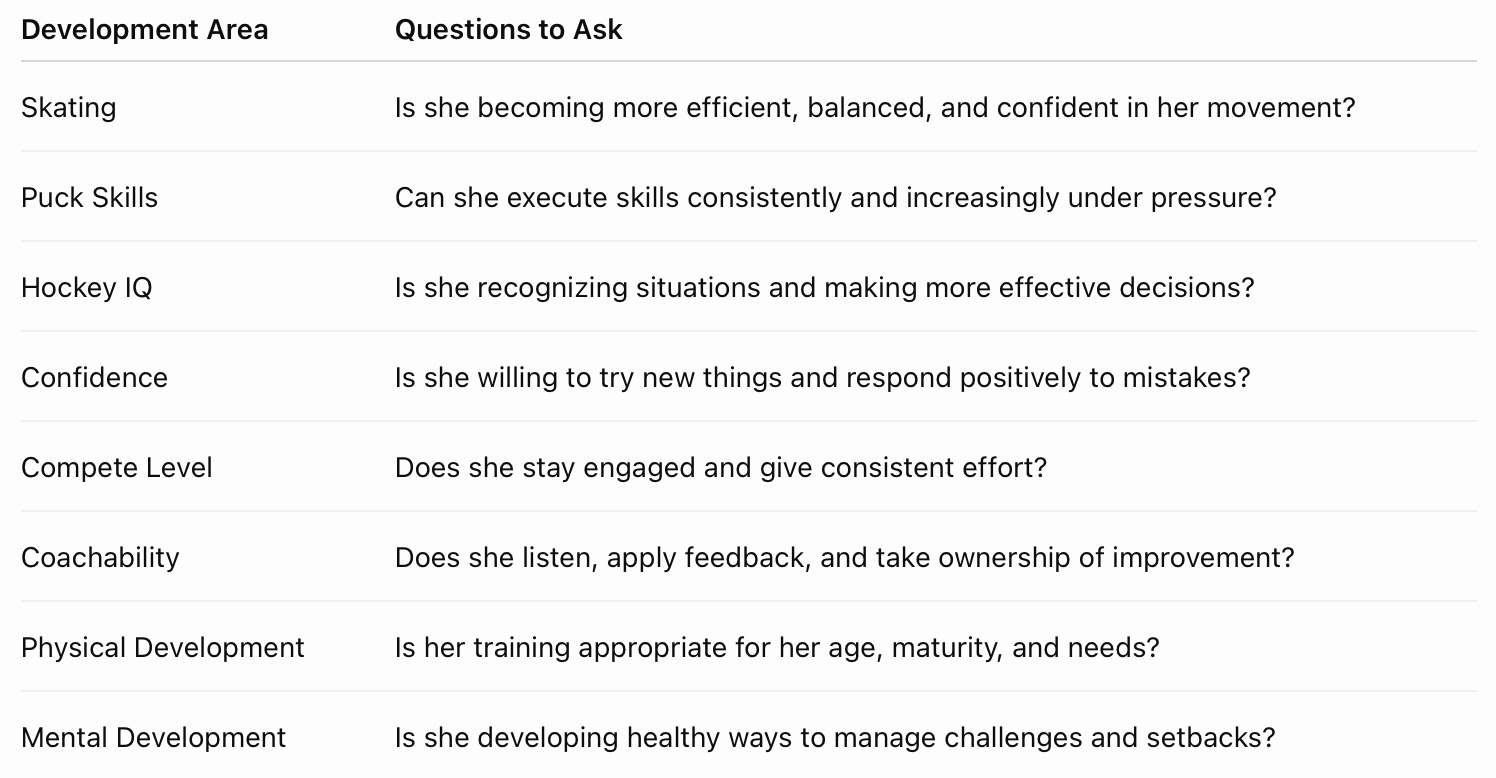
This isn't meant to be a grading system.
It's a conversation starter.
Your daughter should have a voice in identifying her goals and understanding what she wants to improve.
How Breakaway Approaches Player Development
At Breakaway Girls Hockey, we believe strong development requires more than running drills.
It requires intentional coaching, appropriate challenges, and an environment where athletes feel confident enough to learn.
That's why our three-day camps offer two distinct training pathways.
Developmental Pathway
Focused on strengthening fundamentals, improving consistency, building confidence, and helping athletes apply their skills in game situations.
Elite Pathway
Focused on advanced skill execution, higher training speeds, quick decision-making, competitive situations, and performing under pressure.
Both pathways emphasize the same core philosophy:
Meet athletes where they are. Challenge them with purpose. Help them leave better.
Our goal is to help every player understand her strengths, recognize opportunities for improvement, and continue developing long after camp ends.
The Most Important Part of Player Development
It's easy to measure development through goals, assists, wins, and team selections.
But those numbers don't tell the entire story.
Sometimes development looks like a player finally gaining the confidence to carry the puck.
Sometimes it's a better decision in the defensive zone.
Sometimes it's a girl who used to get frustrated after mistakes learning to respond with confidence.
And sometimes it's simply a player who walks into the rink excited to work hard and get better.
Those moments matter.
At Breakaway, we believe the goal isn't to create perfect players.
It's to develop confident, capable, coachable athletes who continue growing throughout their hockey journey.
Ready to Take the Next Step?
Explore Breakaway's three-day camps and development clinics designed to help girls build their skills, strengthen their confidence, and reach their next level.
Her Game. Her Climb. Her Breakaway.