
What's the difference? A parent's guide to recreational hockey, travel hockey, practices, tournaments, costs, and knowing when the next step makes sense.
If your daughter has started playing hockey, you've probably heard the terms house hockey, recreational hockey, and travel hockey thrown around.
But what do they actually mean? And more importantly, how do you know which one is right for your daughter?
For families new to hockey, understanding the different levels can feel overwhelming. Every organization structures its programs a little differently, and it's not always clear when—or if—a player should move from recreational hockey into a more competitive environment.
At Breakaway Girls Hockey, we believe the right hockey experience is the one that supports your daughter's development, confidence, and love for the game.
Let's break down the differences.
What Is House Hockey?
House hockey, sometimes called recreational or in-house hockey, is typically designed for players who want to learn, develop, and enjoy the game in a less travel-intensive environment.
House programs often prioritize skill development, teamwork, participation, and having fun.
Depending on the organization, house hockey may include:
One or two practices per week
Games against teams within the same rink or local area
Limited travel requirements
A shorter or more flexible season
Lower overall costs than travel hockey
Opportunities for beginner and developing players
House hockey is often a great starting point for girls who are learning the game or still discovering how much they enjoy playing.
But don't confuse recreational hockey with a lack of development.
A strong house program with quality coaching can provide an excellent foundation for a young athlete.
For many girls, house hockey is also the perfect long-term fit. Not every player wants the additional time, financial commitment, or competitive pressure associated with travel hockey—and that's completely okay.
What Is Travel Hockey?
Travel hockey is generally a more competitive level of youth hockey that involves additional practices, games, tournaments, and travel.
Players typically participate in tryouts or evaluations, and teams are formed based on factors such as age, skill level, and roster availability.
Travel hockey often includes:
Two or more practices per week
Regular games against other organizations
Weekend tournaments
Out-of-town travel
Longer seasons
Higher registration and participation costs
Greater expectations for attendance and commitment
Travel programs may offer different competitive levels, including A, AA, and AAA, depending on the organization and region.
These designations generally help distinguish levels of competition, but their meaning and availability can vary by league and location.
Travel hockey isn't automatically better hockey. It's a different environment with different expectations.
For athletes seeking more competition, additional training, and a faster-paced development environment, travel hockey can be a valuable opportunity.
The key is making sure the player is ready for—and genuinely interested in—that experience.
House vs. Travel Hockey: What's the Difference?
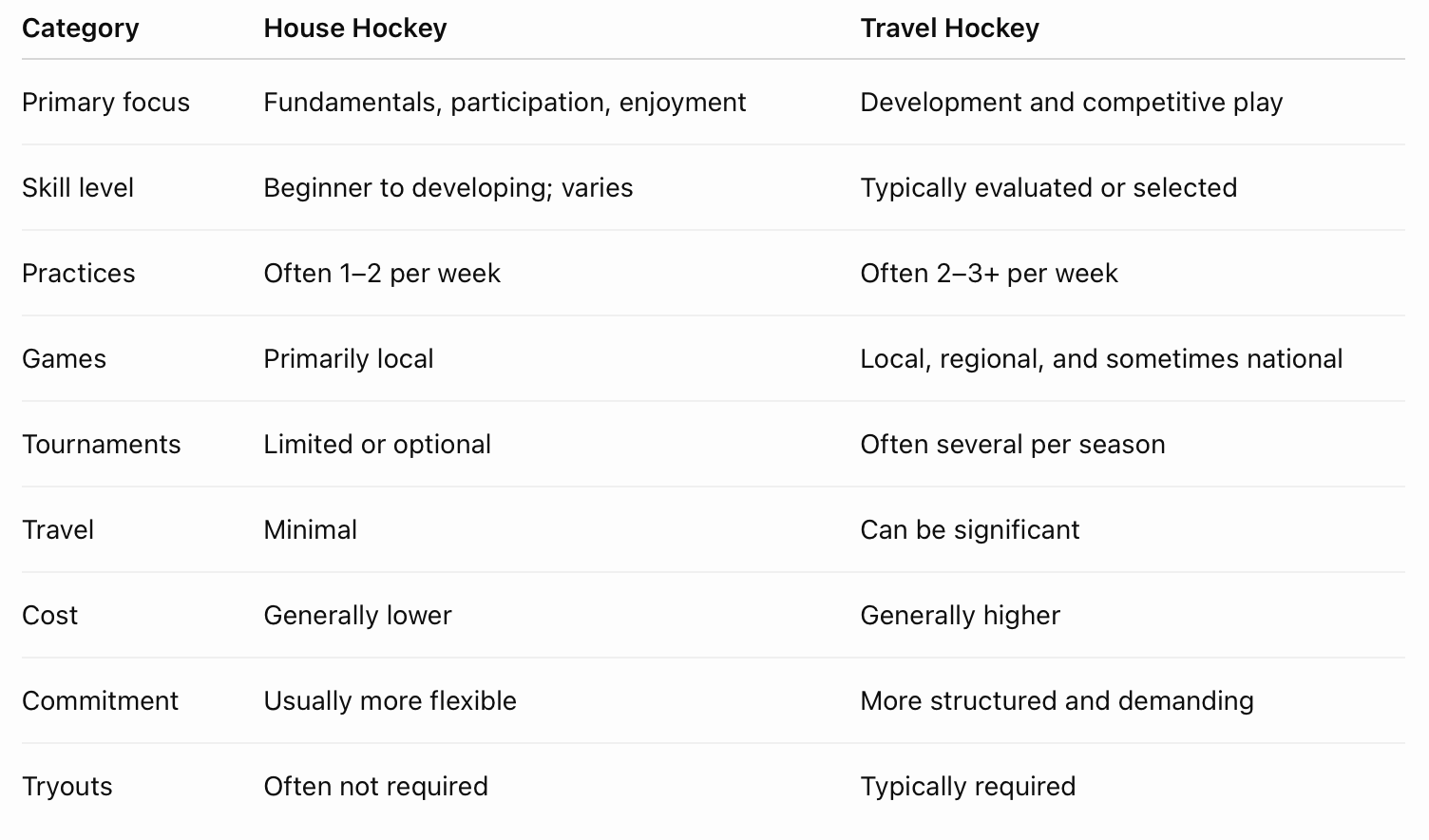
How Much Does Youth Hockey Cost?
One of the biggest differences between house and travel hockey is the financial commitment.
House hockey generally costs less because teams often practice and compete locally, reducing expenses associated with travel, tournaments, and additional ice time.
Travel hockey expenses may include:
Team registration and tuition
Uniforms and team apparel
Tournament entry fees
Hotels and transportation
Meals during travel weekends
Additional training opportunities
Equipment replacement
Team assessments or fundraising obligations
Depending on the organization and competitive level, travel hockey can range from a few thousand dollars to significantly more per season once all expenses are included.
Before committing to a team, ask for a complete breakdown of expected expenses—not just the advertised registration fee.
Breakaway Tip: The most expensive program is not necessarily the best development opportunity. Coaching quality, appropriate competition, and your daughter's overall experience matter far more than the price tag.
When Is Your Daughter Ready for Travel Hockey?
This is one of the most common questions hockey parents ask.
And the answer isn't always based on age, skill level, or how many goals she scores.
A player might be technically ready for travel hockey but not interested in the additional commitment. Another player might be incredibly motivated but still need time to strengthen her skating or puck skills.
Both situations are completely normal.
Here are five things to consider.
1. Does She Want More?
Your daughter's interest should be one of the biggest factors in the decision.
Does she ask to practice outside of scheduled ice time? Does she enjoy challenging herself? Is she excited about the idea of more games and practices?
Travel hockey requires commitment, and that commitment should be something she's interested in—not something she feels pressured to pursue.
2. Does She Have a Strong Foundation?
Skating, puck control, passing, and basic hockey awareness are important building blocks.
Players don't need to be perfect before moving into travel hockey, but they should have enough foundational skills to participate safely and benefit from the pace of the program.
3. Is She Ready for More Competition?
Travel hockey often introduces faster play, more demanding practices, and increased expectations.
Some athletes thrive in that environment. Others benefit from additional time developing confidence and consistency before taking that step.
Neither path is wrong.
4. Is Your Family Ready for the Commitment?
Travel hockey affects the entire family.
Weekend tournaments, early practices, travel expenses, and scheduling conflicts can become a significant part of your routine.
Before making the jump, consider whether the commitment works for your family—not just your athlete.
5. Is the Program the Right Fit?
This might be the most important question of all.
A travel team with limited ice time, poor coaching, or an unhealthy team culture may not be the best place for your daughter to develop.
Look for an organization that values player development, communication, accountability, and a positive team environment.
Remember: Moving to travel hockey should be about finding the right developmental challenge—not simply earning a different label.
Does My Daughter Need to Play Girls-Only Hockey?
Not necessarily.
In many non-traditional hockey markets, girls may have limited access to girls-only teams at certain ages or skill levels.
As a result, some girls play on co-ed teams, while others participate in girls-only programs or a combination of opportunities where permitted.
Both environments can offer valuable experiences.
Co-ed hockey may provide additional local options and competitive opportunities, while girls-only hockey can create meaningful connections, friendships, and a sense of community with other female athletes.
The best choice depends on your daughter's goals, available programs, and the quality of the environment.
At Breakaway, we're passionate about growing girls hockey, but we also recognize that every girl's pathway into and through the sport can look different.
What About A, AA, and AAA Hockey?
As your daughter progresses, you'll likely encounter competitive designations such as A, AA, and AAA.
These labels are commonly used to describe different levels of travel hockey competition.
Generally speaking:
A Hockey: Competitive travel hockey that often emphasizes continued skill development and team play.
AA Hockey: A more advanced competitive environment, typically with higher skill expectations and stronger competition.
AAA Hockey: Often among the highest levels of youth travel hockey, with demanding schedules and significant competitive commitments.
However, these classifications are not perfectly standardized across every region, league, or organization.
A team labeled AA in one market may face a different competitive environment than an AA team elsewhere.
Rather than focusing exclusively on the letters, ask about coaching quality, the team's actual competitive schedule, practice structure, and your daughter's opportunities to develop.
The right level is the one where she can be challenged, contribute, learn, and continue growing.
Can a House Hockey Player Eventually Play at a Higher Level?
Absolutely.
There is no single timeline for hockey development.
Some athletes begin playing travel hockey at a young age. Others spend several years in recreational programs before moving into a more competitive environment.
Players develop physically, mentally, and technically at different rates.
What matters is building a strong foundation, developing good habits, and finding opportunities that match their current needs.
Moving into travel hockey later does not automatically close the door to future competitive opportunities, although available pathways become more selective as players get older.
And just as importantly, not every player needs to pursue elite hockey for her hockey journey to be successful.
Questions Every Parent Should Ask Before Choosing a Team
Before registering your daughter for a house or travel program, consider asking:
What is the organization's coaching and player development philosophy?
How much ice time and instruction will players receive each week?
How are players evaluated and placed on teams?
What is the expected time commitment?
What is the total estimated cost, including tournaments and travel?
How does the organization communicate with parents?
What opportunities exist for girls within the program?
How does the organization handle playing time, athlete feedback, and player development?
These conversations can tell you much more about a program than its competitive designation alone.
The Most Important Thing? Keep Her Love for the Game.
It's easy to get caught up in team selections, competitive levels, tournaments, and what other players are doing.
But youth hockey is a journey, not a race.
Your daughter doesn't need to follow the same path as her teammates. She doesn't need to play travel hockey by a certain age. And she certainly doesn't need to measure her success against someone else's timeline.
What she needs is an environment that challenges her appropriately, supports her growth, and keeps her excited to come back to the rink.
At Breakaway Girls Hockey, that's exactly what we believe development should look like.
Through our Developmental and Elite camp pathways, skills clinics, and educational resources, we aim to support girls at every stage of their hockey journey.
Whether she's playing her first season of house hockey or preparing for a highly competitive travel program, her development matters.
Every Girl. Every Stage. Every Opportunity.
Explore Breakaway Girls Hockey's camps, clinics, and parent resources to help your daughter find her next step.
Her Game. Her Climb. Her Breakaway.