
Your guide to competitive youth hockey levels, tryouts, and finding the right environment for your daughter's development.
If you've spent any time around youth hockey, you've probably heard parents talking about A, AA, and AAA teams.
Maybe your daughter is preparing for her first travel hockey tryout. Maybe she's playing A hockey and wondering whether she's ready for AA. Or perhaps you've heard that AAA is where serious players need to be if they want to play college hockey.
But what do these letters actually mean?
And does playing at a higher level automatically mean your daughter is getting better development?
Not necessarily.
At Breakaway Girls Hockey, we believe the best environment for an athlete isn't always the one with the highest designation. It's the one that challenges her appropriately, develops her skills, builds her confidence, and supports her long-term goals.
Let's break down the different levels of youth hockey and what parents should consider when making decisions.
First, What Do A, AA, and AAA Mean?
A, AA, and AAA are competitive classifications commonly used in youth travel hockey.
Generally, the more letters a team has, the higher the intended level of competition.
However, these classifications aren't perfectly standardized across the country. Their definitions, availability, and competitive strength can vary by league, region, and governing body.
Here's a general comparison:
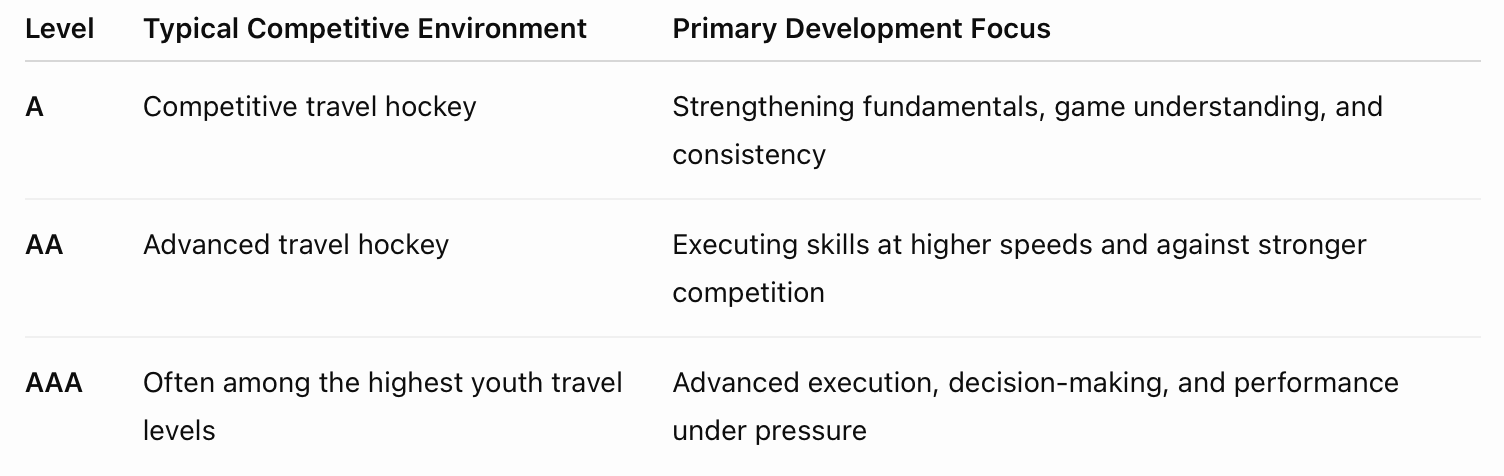
A Hockey: Building a Competitive Foundation
A hockey is often an entry point into competitive travel hockey, although some players participate at this level for many years.
Players generally have foundational skating and hockey skills and are ready for more structured practices, games, and competition.
At this level, development often emphasizes:
Skating technique, edges, speed, and balance
Passing, shooting, and puck control
Positioning and basic hockey systems
Hockey IQ and decision-making
Confidence and consistency in game situations
Teamwork, accountability, and compete level
A hockey can be an excellent environment for players transitioning from recreational hockey or continuing to strengthen their fundamentals.
What parents should know: Playing A hockey doesn't mean your daughter isn't talented or serious about the sport.
A player who receives quality instruction, meaningful ice time, and appropriate competition at the A level may develop more effectively than she would in an environment where she's consistently overwhelmed.
AA Hockey: Raising the Pace and Expectations
AA hockey generally represents a more advanced competitive environment.
Players are typically expected to demonstrate stronger fundamentals, greater consistency, and the ability to execute skills at a faster pace.
The biggest difference isn't necessarily that AA players know completely different skills.
It's often how quickly, consistently, and effectively they can perform those skills under pressure.
AA development may emphasize:
Faster skating and improved acceleration
Stronger puck control under defensive pressure
Quicker reads and decision-making
Advanced positional awareness
More demanding competitive situations
Greater consistency and individual accountability
AA hockey can be a strong fit for athletes who have developed a solid foundation and are ready for a more challenging environment.
However, the expectations vary by organization.
A player should be evaluated based on her readiness for the specific team—not simply the letters attached to it.
AAA Hockey: High-Level Competitive Development
AAA is commonly associated with some of the highest levels of youth travel hockey.
These programs often feature highly skilled players, demanding schedules, significant travel, and competition against strong regional or national opponents.
At this level, athletes may be expected to demonstrate:
Advanced skating and technical execution
Strong hockey IQ and anticipation
Quick decisions under significant pressure
High levels of consistency and competitiveness
Strong practice habits and personal accountability
The ability to adapt to faster, more physical game situations
AAA programs can provide valuable development opportunities for athletes prepared for that environment.
But AAA also comes with important considerations.
Higher costs, extensive travel, increased time commitments, and greater competitive demands can affect both athletes and families.
The AAA designation doesn't guarantee better coaching, stronger development, or future recruiting opportunities.
Parents should evaluate the actual program rather than assuming the classification tells the whole story.
Does Playing AAA Mean My Daughter Will Play College Hockey?
This is one of the biggest misconceptions in youth hockey.
Playing AAA may provide opportunities to compete against strong opponents and participate in events attended by college coaches.
However, AAA hockey does not guarantee college recruitment, a scholarship, or a roster spot.
College coaches evaluate individual athletes, not just the letters on their jerseys.
Factors that may influence recruiting include skating, hockey IQ, skill execution, consistency, competitiveness, coachability, academic fit, and performance against appropriate competition.
The level of competition an athlete faces can matter, especially as she approaches college recruiting age. But it is only one part of her overall development and recruiting profile.
For girls in non-traditional hockey markets, access to AAA programs may also be limited.
Some athletes must travel considerable distances to find advanced competition, while others develop through AA teams, co-ed programs, high school hockey, camps, or other opportunities.
There isn't one universal route.
Breakaway Tip: If college hockey is a goal, focus on building a strong athlete, understanding the recruiting process, and finding appropriate competitive opportunities—not simply chasing a team designation.
Is It Better to Be a Top Player on AA or a Bottom Player on AAA?
This is a question many hockey families eventually face.
And the answer depends on the individual athlete and the programs involved.
Being a top player on an AA team may provide opportunities to handle the puck more often, play in important situations, build confidence, and develop leadership skills.
Playing on a AAA team may expose an athlete to faster competition, stronger teammates, and higher expectations that accelerate her development.
Neither situation is automatically better.
Consider these questions:
Will she receive meaningful development opportunities?
Look beyond game statistics. Consider practice quality, coaching attention, skill development, and opportunities to improve.
Will she be appropriately challenged?
An athlete needs enough challenge to grow without being consistently overwhelmed or disengaged.
Is she developing confidence and decision-making?
Confidence doesn't mean everything should feel easy. It means she has the support and opportunities to learn from mistakes and continue competing.
Does the coaching staff have a plan for her development?
A strong coach should be able to explain what your daughter does well, where she needs to improve, and how the program will help her progress.
Does she enjoy the environment?
A challenging environment should still be one where your daughter feels respected, supported, and motivated to improve.
The best decision is rarely as simple as choosing the highest level available.
How Do Hockey Tryouts Work?
Tryouts are used by many travel hockey organizations to evaluate players and form teams.
Depending on the organization, evaluations may include skating drills, puck skills, small-area games, scrimmages, and competitive situations.
Coaches may assess:
Skating ability and mobility
Puck handling, passing, and shooting
Hockey IQ and positional awareness
Decision-making under pressure
Compete level and effort
Coachability and attitude
Team needs and roster composition
Some organizations also consider previous-season performance or observations from coaches.
Tryout processes vary, and evaluations are not always perfect.
A player may have an outstanding tryout and still not make a particular roster. Another may struggle during evaluations but demonstrate strong long-term potential.
One tryout does not define your daughter's ability or future in hockey.
What If My Daughter Doesn't Make the Team She Wanted?
Not making a team can be disappointing, especially when an athlete has worked hard toward a specific goal.
As a parent, one of the most valuable things you can do is help her view the experience as part of her development rather than a final judgment of her potential.
Give her space to be disappointed.
Then, when she's ready, help her identify what comes next.
Consider asking the organization for constructive feedback, identifying two or three areas for improvement, and finding opportunities to work on those skills.
A different team placement may create opportunities for greater confidence, increased responsibility, and meaningful development.
The goal isn't to prove the evaluators wrong. It's to help your daughter continue becoming a better player.
And sometimes, the best response to a setback is simply getting back to work.
Five Questions Parents Should Ask Before Choosing a Level
Before accepting a roster spot, take time to understand the environment your daughter will be joining.
1. What is the coaching philosophy?
Does the program prioritize long-term player development, or is the focus almost entirely on winning games?
Competitive success and development can coexist, but the approach matters.
2. How are practices structured?
Ask how much time is dedicated to individual skill development, game situations, team systems, and teaching.
A strong practice environment can be more valuable than an impressive tournament schedule.
3. How does the program support individual development?
Will players receive feedback? Are coaches approachable? Is there a plan to help athletes improve throughout the season?
4. What is the full commitment?
Understand tuition, travel, tournaments, practice frequency, attendance expectations, and additional costs.
The right program needs to work for the entire family.
5. Is this the right environment for my daughter right now?
Not where she was last season. Not where her friends are playing. Not where another parent thinks she should be.
Where is she today, and what environment will help her take the next step?
Why Development Doesn't Always Follow a Straight Line
One of the most important things to understand about youth hockey is that players develop at different rates.
Some girls develop advanced skating skills early. Others become stronger players as they grow, gain confidence, and improve their hockey IQ.
Physical development, coaching quality, practice habits, access to ice, and individual motivation all influence progress.
A player who competes at AA one season may be ready for AAA later.
Another athlete may benefit from remaining at the same level while improving her consistency and confidence.
And some girls may decide that a less demanding competitive environment better supports their goals.
None of these paths represents failure.
Development is about progress, not labels.
How Breakaway Approaches Player Development
At Breakaway Girls Hockey, we believe athletes deserve training that meets them where they are while challenging them to improve.
That's why our three-day camps offer two distinct training pathways.
Developmental Pathway
Designed for athletes who are strengthening their fundamentals, building consistency, and developing confidence.
Training emphasizes skating, puck skills, hockey IQ, decision-making, and purposeful repetition.
Elite Pathway
Designed for experienced, competitive athletes ready to execute advanced skills at higher speeds and under greater pressure.
Training emphasizes advanced technical application, quick decisions, competitive situations, and high-tempo development.
These pathways are not determined solely by whether a player competes at A, AA, or AAA.
During registration, parents select the pathway they believe best fits their daughter. Breakaway then reviews the registration to help ensure appropriate placement.
An AA player may be ready for our Elite pathway, while a AAA player may benefit from focused fundamental development.
Our goal is to provide the right training environment for each athlete—not assign value based on a team label.
The Bottom Line: The Letters Don't Define the Player
A, AA, and AAA can help families understand the general competitive structure of youth hockey.
But they don't tell the entire story.
They don't measure your daughter's character, work ethic, leadership, or long-term potential.
And they certainly don't determine how much she should love the game.
As parents, it's natural to want the best opportunities for our children.
But sometimes the best opportunity isn't the highest level, the most expensive program, or the team with the biggest reputation.
Sometimes it's the environment where your daughter receives great coaching, feels challenged, builds confidence, and can't wait to get back on the ice.
At Breakaway, that's the kind of development we believe in.
Because the goal isn't to chase letters. It's to develop players.
Find the Right Development Opportunity With Breakaway
Explore our three-day camps and skills clinics designed to help girls develop their game at every stage.
Her Game. Her Climb. Her Breakaway.